
Reviewed · BELFAST BLACK TAXI & MURAL TOURS
Belfast Troubles Murals Street Art and Peace Wall Walking Tour
Belfast’s murals are not just colorful walls. They are public history, political statements, memorials, and signs of a city still working through its past. This three-hour walk takes you from the Cathedral Quarter into Shankill Road and West Belfast, where the artwork becomes a guide to the Troubles and to life in Belfast today.
I like two things right away: you see both loyalist and republican areas, and the small group of no more than eight people can move through local neighborhoods with less fuss. I also like the focus on present-day healing, not just old conflict. The main drawback is pace. You may cover more than 6 kilometers in three hours, and guide Marty’s information-heavy style can feel intense.
Key points at a glance
- A walk across Belfast’s dividing line: See loyalist murals on Shankill Road, republican art in West Belfast, and the Peace Wall between communities.
- More than political murals: The route also includes international street art and community-led re-imaging projects.
- Marty’s local perspective: Expect a detailed account of Belfast’s past, present, and hopes for the future from a Belfast native.
- A brisk six-kilometer outing: Wear comfortable shoes and be ready to keep moving while listening.
- Adults only: The experience is not suitable for anyone under 18.
- Good value at $36.11: A small-group, three-hour introduction costs less than many private sightseeing experiences, though shopping and restaurant discounts are the only extras listed.
Why Belfast’s murals tell a bigger story
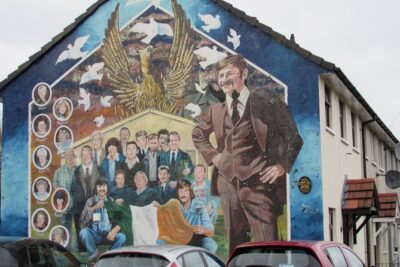
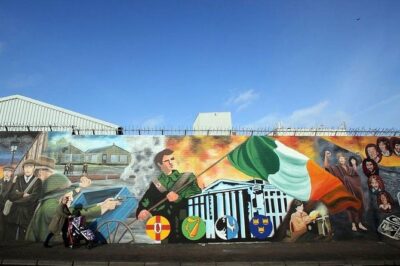
You can look at a Belfast mural as street art, but you’ll get much more from it when you understand who painted it, who paid for it, and what message it sends to the surrounding community. A portrait, flag, slogan, or memorial can point toward identity, loss, loyalty, protest, or a desire to move on.
This walk uses those walls as stopping points for a wider story. You’ll hear about the Troubles, the period of civil and political conflict that shaped Northern Ireland for decades, but the tour also reaches further back into the island’s complicated past. The aim is not to reduce Belfast to a simple struggle between two sides.
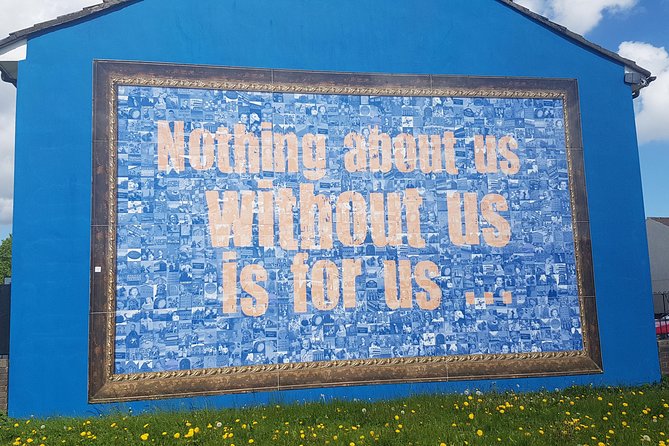
I especially like the way the route includes newer community art alongside the more famous political murals. The re-imaging work is meant to replace or add murals that local communities want to share, giving neighborhoods more control over how they are seen. That shift matters. It shows Belfast as a living city rather than a museum of conflict.
The subject is serious, and the tone can be personal. Marty draws on local experience and spends time explaining how ordinary people lived through the violence and how later generations are trying to recover. If you want a light art walk with quick photo stops, this is not the right choice. If you want context and a candid look at difficult subjects, it offers far more.
Other black taxi and mural tours:
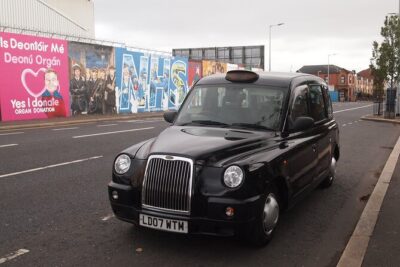
- Cab Tours Belfast Famous Black Taxi Tours
★ 5.0 · 3,633 reviews - Private Black Taxi Belfast City Tour
★ 5.0 · 2,188 reviews - Belfast’s Political Mural Taxi Tour
★ 5.0 · 1,180 reviews
Starting in the Cathedral Quarter
The walk begins at Exchange Street West in Belfast city center, close to the Cathedral Quarter. This first section lasts about 30 minutes and introduces Belfast’s newer street-art scene before the route turns toward the political murals of the west.
That opening is useful because it gives you a visual reset. You are not dropped straight into the most charged images. Instead, you start with modern work by international street artists and see how Belfast has become known for a broader public-art scene.
The Cathedral Quarter is also a practical meeting point. It is central, near public transport, and easy to reach before the walk. Arrive ready to start on time, since the route has a lot of ground to cover and does not linger at every wall.
The guide may spend considerable time talking before the route reaches the Peace Wall. That historical setup helps make later stops clearer, but it also explains why some people find the presentation dense. Keep questions in mind and listen for the links between the artwork, local identity, and the political events being discussed.
Shankill Road and the loyalist murals
The next listed stop is Shankill Road, where you’ll see loyalist murals and local street art. The formal stop is about 15 minutes, but the route around it forms part of the larger story of Belfast’s divided communities.
Shankill Road is not simply a backdrop for photographs. It is a lived-in neighborhood, so behave as you would anywhere else in a residential area. Listen carefully, avoid blocking pavements, and take photographs with discretion. The value of walking here is that you see the murals in their own surroundings rather than as isolated images reached by taxi.
Marty’s approach aims to explain more than one viewpoint. The route later includes republican areas, so you are not given only one community’s visual record. That balance is one of the tour’s strongest features, especially if your understanding of the Troubles comes mainly from headlines or a short guidebook chapter.
The pace can be brisk on this part of the route. You will want good walking shoes, and you should not expect a long pause at every mural. If you need frequent rest stops, this three-hour format may feel demanding.
The International Mural Wall on Divis Street
From Shankill Road, the walk continues to the International Mural Wall on Divis Street. Here the art turns outward, with murals connected to causes from around the world. This stop lasts about 15 minutes.
The International Mural Wall adds an important layer to the tour. Belfast’s public art is not limited to local flags and local political memories. The wall connects the city’s own experience of conflict with wider campaigns and struggles, allowing you to compare Belfast’s visual language with messages from other places.
This is also a good point to notice the difference between street art and traditional political murals. Some pieces may be created for a broad public audience, while others speak most directly to people who live nearby. Marty explains these differences as part of the larger route.
You should expect plenty of information in a short period. The tour covers ancient background, modern conflict, local communities, art, and peace work in roughly three hours. I would not try to absorb every date. Pay attention to the main sequence of events and ask yourself what each mural says about the community that displays it.
A few more Belfast half-days to weigh up
- Belfast Music and Street Art Small Group Guided Experience
★ 4.5 · 62 reviews
The Peace Wall and the meaning of separation
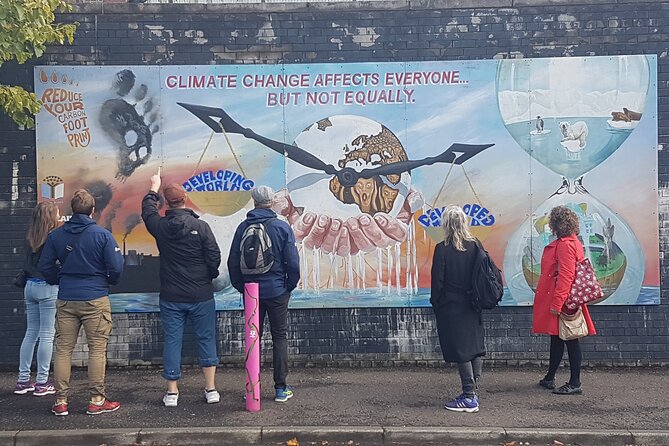
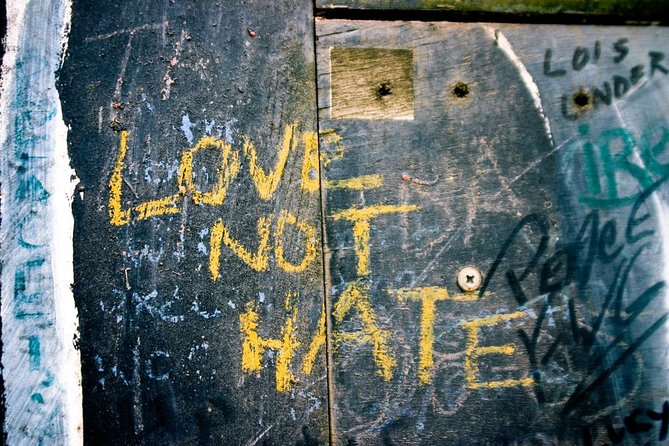
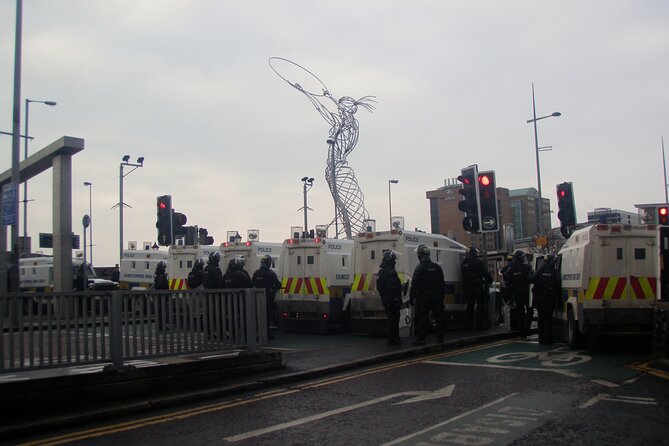
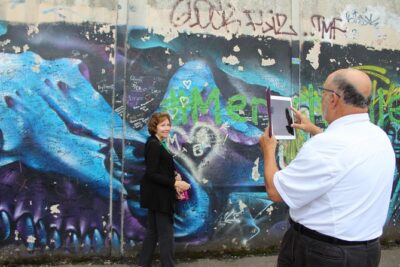
The Peace Wall is one of the most recognizable parts of the Belfast experience. The wall separates communities that were once caught in repeated violence, and it remains a physical reminder that peace does not automatically erase fear or mistrust.
The stop itself is listed at about 10 minutes, so do not expect an extended visit. The wall is free to view, but no admission ticket is included because this is an outdoor stop. Its importance comes from the explanation and the setting, not from an indoor exhibit or formal attraction.
What I find valuable here is the chance to consider the gap between a peace agreement and everyday reconciliation. A wall can reduce immediate danger while also showing how much work remains. The tour’s repeated emphasis on healing and the needs of future generations gives this stop more weight than a simple photo opportunity.
The Peace Wall can also be an emotionally difficult place. You may see messages, symbols, or artwork tied to painful events. This is an adults-only activity, and that restriction fits the subject matter. It is worth approaching the stop with respect rather than treating it as a dramatic prop.
The Bobby Sands mural in West Belfast
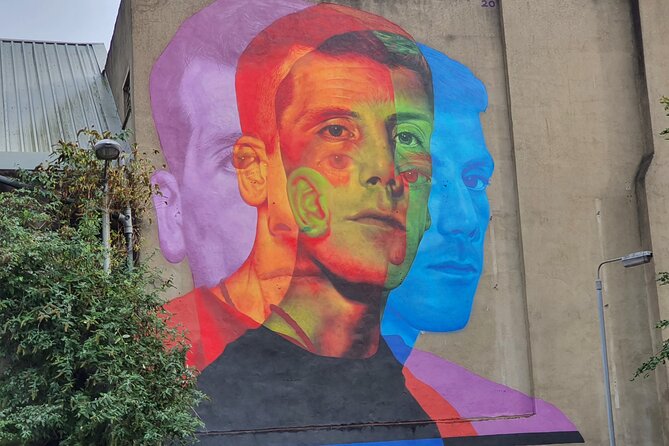
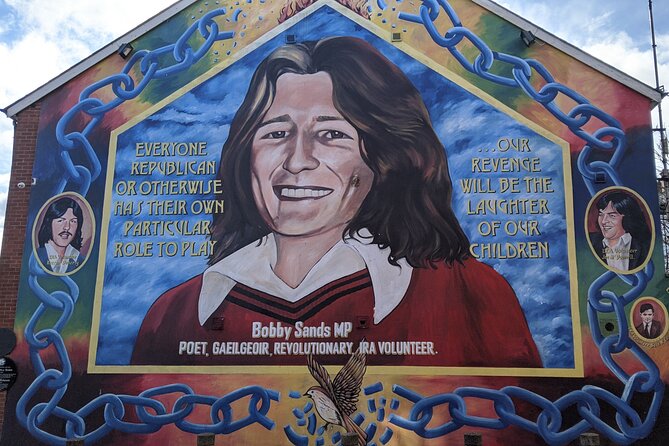
The Bobby Sands mural is the best-known stop in the republican area of West Belfast. The listed viewing time is only about five minutes, but the mural carries considerable political and historical meaning.
Bobby Sands was a prominent republican figure whose death became a major part of the international story of the Troubles. The mural has become one of Belfast’s most photographed images, but a photograph alone tells you very little. Marty’s explanation places it within the political history and the experience of the surrounding community.
This stop also shows why a local guide matters. A guide can help you understand the difference between what a visitor sees and what a mural means to people who live with it every day. You will not get the same context by following a map from one famous wall to another.
Again, act carefully in the neighborhood. Keep the group together, listen to instructions, and remember that West Belfast is a home for local residents, not an open-air theme park. That respectful approach is part of what makes the walk worthwhile.
Street art, re-imaging, and Belfast today
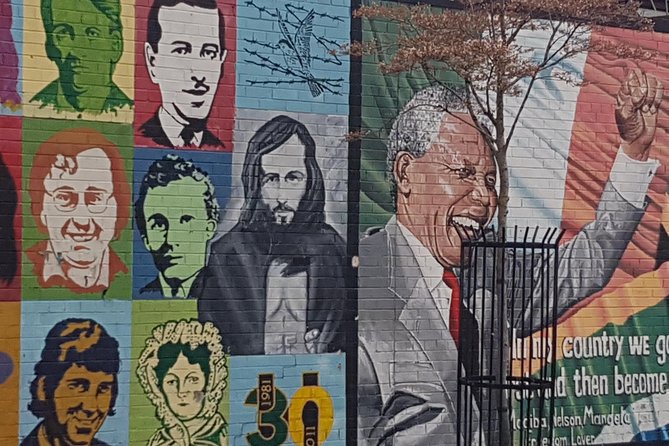
The tour does not finish with the Troubles. As you return toward the city center, you pass more street art and political murals, along with community projects designed to change how public spaces look and feel.
The re-imaging idea is especially useful for understanding Belfast now. It gives local communities a role in deciding which images they want to put forward. That can mean replacing older political material, adding art with wider appeal, or creating murals that support a shared future.
This part of the walk keeps the experience from becoming fixed in the past. Belfast is still marked by the conflict, but it is also trying to build a different public identity. The artwork becomes a record of that transition.
The walk finishes at Kelly’s Cellars on Bank Street, with the option to continue a short distance toward Belfast City Hall and 2 Royal Avenue, a local community center. That ending is convenient if you want to carry on exploring the center, stop for food, or use the shopping and restaurant discounts provided with the experience.
Marty’s guiding style and what to expect
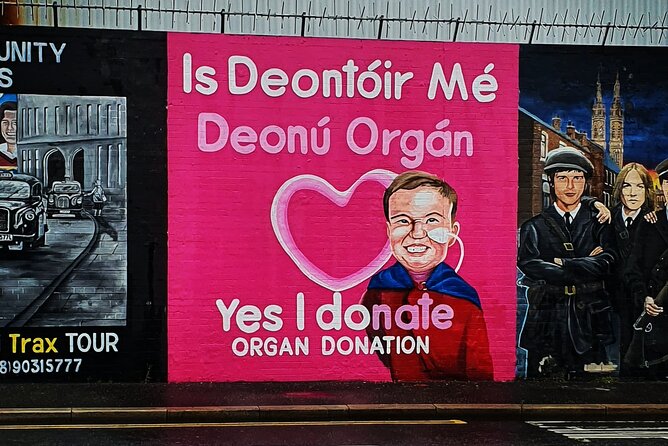
Marty is the guide named for this experience, and his strength is the amount of background he brings to the walk. He explains Belfast’s history in detail, includes personal knowledge of the city, and connects the murals to the healing process now under way.
His style is closer to a spoken history lesson than to a polished, scripted sightseeing show. He may ask what you know about a subject before explaining it. Some people find that a useful way to begin a discussion, while others may find the question awkward or feel that the delivery is too forceful.
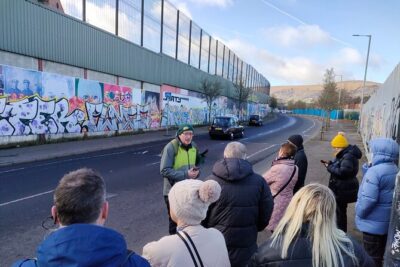
You should also expect a guide who talks a lot and walks quickly. There is no microphone, so stay near Marty if you want to catch every word. The group size is capped at eight, which helps with conversation and makes it easier to move through the neighborhoods without forming a large crowd.
The tour’s high rating, 4.8 out of 5 from 163 ratings, reflects how well this approach works for many people. Still, the experience is not likely to suit everyone. If you prefer a quiet guide, a slow pace, or a short introduction with plenty of free time, you may find the presentation too packed.
How much value do you get for $36.11?
At $36.11 per person, this is a reasonable price for a three-hour small-group walk covering central Belfast, Shankill Road, Divis Street, the Peace Wall, and West Belfast. You are paying for a local guide and access to a carefully connected route, not for entry to a museum or a private vehicle.
The value is strongest if you are new to Belfast and want a clear starting point for understanding the city. You see a wide range of art, cover both sides of the community divide, and hear about current efforts to create peace. That can save you from seeing the murals as disconnected images.
The price is less appealing if you mainly want quick photographs. The route includes long stretches of walking and extended explanation, so the benefit comes from the story rather than from the number of stops. Shopping and restaurant discounts are provided, but no meal, transport, or attraction admission is included.
The tour is booked about 19 days ahead on average, so I would reserve early if your Belfast dates are fixed. Free cancellation is available up to 24 hours before the start time. Inside that window, you do not receive a refund, and late changes are not accepted.
Shoes, weather, and the practical details
Plan for roughly 2.5 to 3 hours, with a brisk pace and possibly more than 6 kilometers on foot. Comfortable shoes are essential. This is not the moment for new boots, thin fashion shoes, or anything that makes you shorten your stride.
Belfast weather can change quickly. Bring a rain jacket and dress in layers, since it may be colder than you expect. Sunglasses are optional, but sunscreen is sensible in summer. The tour runs outdoors, so poor weather can affect your comfort even when the walk continues.
The route is near public transportation, and the start is in the city center. No special health restrictions are listed, but you should have a moderate level of physical fitness. Since there is no microphone, staying close to the guide is wise.
The activity is offered in English and uses a mobile ticket. Confirmation is received at booking. It is specifically for adults and is not suitable for anyone under 18.
Who should book this walk?
I would choose this tour early in a Belfast visit if you want the city’s murals to make sense. It is particularly useful for first-time visitors who want both loyalist and republican perspectives, as well as a look at the city’s modern street-art scene.
It also suits people who enjoy local voices and detailed storytelling. The small group, personal approach, and neighborhood route offer a closer experience than a drive-by mural tour. You will see more on foot and get a better sense of how the art fits into everyday streets.
I would pause before booking if you have limited mobility, dislike brisk walking, or want a short, relaxed outing. I would also think twice if serious political history feels too heavy for your trip. The guide’s manner is direct, and the amount of information can be a lot.
Should you book the Belfast Murals and Peace Wall walk?
Book it if you want more than a photograph of the Peace Wall. For $36.11, you get a small-group introduction to Belfast’s murals, political divisions, community art, and hopes for peace, guided by a local who knows the subject personally.
Go prepared for six kilometers, changing weather, a fast walking pace, and a talk-heavy presentation. Wear comfortable shoes, stay close to Marty, and give the neighborhoods the respect they deserve. If that sounds like your kind of afternoon, this is one of the most useful ways to begin understanding Belfast.
FAQ
How long does the Belfast Murals and Peace Wall Walking Tour last?
The walk lasts approximately three hours, with the route described as about 2.5 to 3 hours.
How much does the tour cost?
The listed price is $36.11 per person.
Where does the tour start?
The tour starts at Exchange Street West, Exchange St W, Belfast BT1, UK.
Where does the tour finish?
The main finish is at Kelly’s Cellars, at 32 Bank Street, Belfast BT1 1DA. You can also continue a short walk toward Belfast City Hall and 2 Royal Avenue.
What places are included on the route?
The route includes the Cathedral Quarter, Shankill Road, the International Mural Wall on Divis Street, the Peace Wall, the Bobby Sands mural, and additional street art and political murals on the return to the city center.
Is the Peace Wall admission included?
The Peace Wall is an outdoor stop, and no admission ticket is included or required for the listed visit.
Is the tour suitable for children?
No. This is an adults-only activity and is not suitable for anyone under 18.
How many people can join the tour?
The group has a maximum of eight participants.
What should I wear for the walk?
Wear comfortable walking shoes and dress for changing weather. Rain and colder conditions are possible, while sunglasses and sunscreen may be useful in summer.
More Walking Tours in Belfast
- A History of Terror – Belfast City Centre Walking Tour
★ 5.0 · 2,883 reviews - Belfast Political Tour-Conflicting Stories Walking Tour
★ 4.5 · 459 reviews - Best of Belfast Walking Tour
★ 5.0 · 399 reviews - Belfast Eclectic Walking City Center Experience, The Marti Way
★ 5.0 · 348 reviews
Just added around Belfast
- Game of Thrones scene location inc Giants causeway from Belfast★ 5.0 · 3 reviews
- Belfast history of terror & mural 1 hr express private taxi tour★ 5.0 · 3 reviews
- Giants Causeway Tour From Belfast including Game of thrones sites★ 5.0 · 3 reviews
- Experience the Antrim Coast and the Land of Giants – Private Tour★ 5.0 · 3 reviews
- Private Coast Tour in Belfast★ 5.0 · 3 reviews
- Belfast & Giants Causeway Luxury Mercedes Private Tour for 6 pax★ 5.0 · 3 reviews
- Belfast to Dublin Transfer★ 5.0 · 3 reviews
- Belfast City Airport (BHD) to Belfast Accommodation – Arrival Private Transfer★ 5.0 · 3 reviews
Belfast Black Taxi & Mural Tours, compared.
Cab Tours Belfast Famous Black Taxi Tours
See the full review →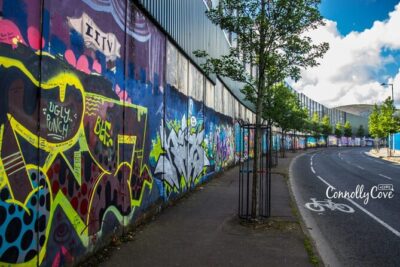
Browse the lists this tour appears in