
Reviewed · BELFAST BLACK TAXI & MURAL TOURS
Belfast Famous Black Taxi Tour Political Murals & Peace Wall 2 Hr
Belfast’s political murals make the city’s divided past visible on street corners, gable walls, and memorial gardens. This private black taxi tour takes you through the Falls and Shankill districts, where your driver explains how The Troubles shaped local life, politics, and public art.
I like the small private setting, which lets you ask questions without a busload of strangers listening in. I also like the generous number of photo stops, especially at the International Wall, Bobby Sands mural, and Peace Wall. The drawback is the short two-hour length: the subject is large, and some stops receive only 10 or 15 minutes.
Key points to know
- A local driver explains both sides: Hear about nationalist communities on the Falls Road and loyalist communities on the Shankill Road.
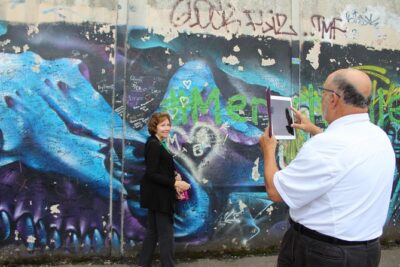
- The Peace Wall is still real, not just a museum display: You can add your name and a message of hope alongside notable signatories.
- Several stops offer strong photo chances: Expect time at murals, memorials, the International Wall, and the Shankill area.
- Pickup is convenient in central Belfast: Free pickup is available within 1 kilometer of Belfast City Hall.
- The tour is private: Only your group takes part, making it easier to ask sensitive questions.
- Plan for a serious, sometimes sobering visit: The guide covers deaths, prison history, paramilitary groups, and the conflict that began in 1969.
Why a black taxi is the right way to see Belfast’s divided streets
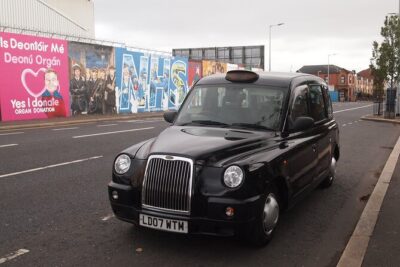
A black taxi gives this tour a practical advantage. Belfast’s political story is tied to specific neighborhoods, not just to a central museum. You move through the streets where the conflict played out, while the driver links murals, walls, churches, memorials, and local identities together.
The taxi also keeps the tour intimate. Since only your group participates, you can ask for clarification when a political term or event is unfamiliar. That matters in Belfast, where a casual question can carry more weight than you expect. One account of the experience described feeling unsure at first about what was safe to say. The sensible approach is simple: listen carefully, ask respectfully, and let your driver set the tone.
This is not a cheerful sightseeing ride. You will hear about civilian casualties, republican prisoners, loyalist organizations, imprisonment, and the violence that began in 1969. Yet the tour also points toward the peace process and the messages of hope written on the Peace Wall. That mix of hard facts and cautious optimism gives the experience its value.
Other black taxi and mural tours:
- Cab Tours Belfast Famous Black Taxi Tours
★ 5.0 · 3,633 reviews - Private Black Taxi Belfast City Tour
★ 5.0 · 2,188 reviews - Belfast’s Political Mural Taxi Tour
★ 5.0 · 1,180 reviews
Divis, Falls Road, and the International Wall
The tour begins around Divis and Falls Road, the heart of Belfast’s republican and nationalist community. The area includes the former Divis Flats, where the British Army occupied the top three floors until 2007. Even if you are not familiar with Belfast’s urban history, this detail helps explain how military presence became part of daily life.
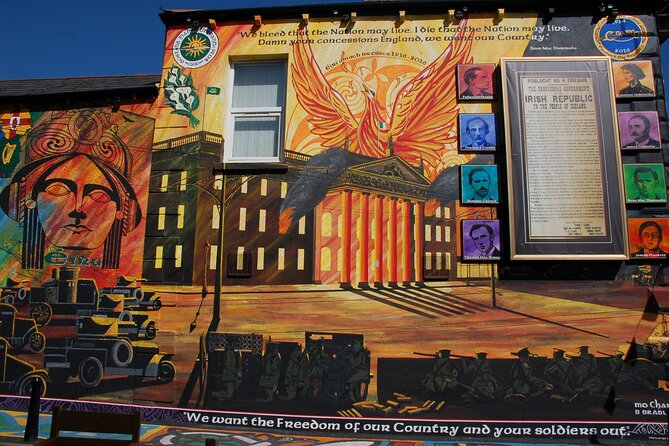
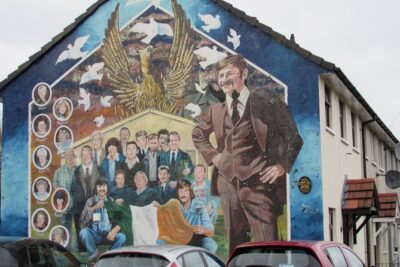
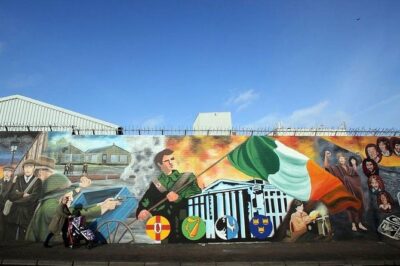
You then reach the International Wall, one of the strongest early stops for understanding Belfast’s street art. Murals here do more than decorate blank walls. They commemorate people, events, political causes, and cultural identity. The themes change depending on the community that created them, so your driver’s explanation is essential.
You get about 15 minutes around Divis and 10 minutes at the International Mural Wall. That is enough for a quick look and photographs, but not enough to study every image. A useful tip is to arrive ready to listen rather than trying to photograph everything at once. The wall carries a lot of information, and the story behind a mural often matters more than its color or size.
A Belfast mural guide once estimated about 300 quality murals in the city, with many others in various stages of age and decay. You will not see all of them here, of course, but this tour shows why Belfast’s murals are treated as historical documents as much as public art.
The Peace Wall and messages left behind
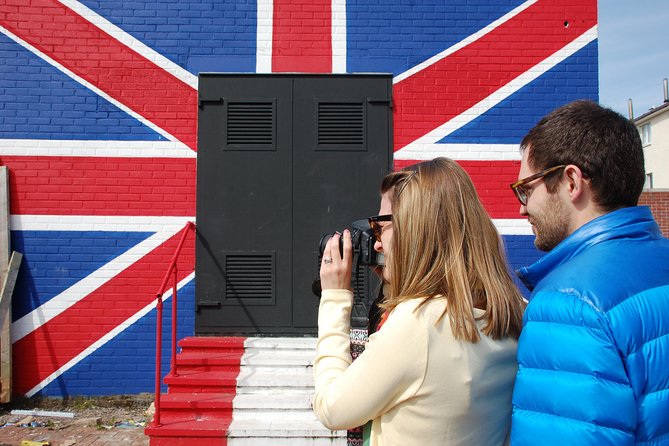
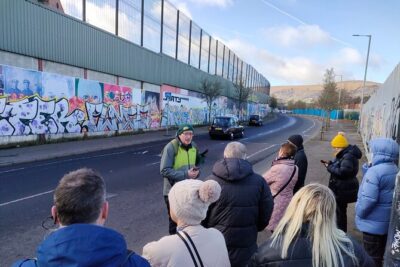
The Peace Wall is the emotional center of the ride. It still divides Belfast, and the broader network of more than 40 peace walls stretches for about 20 miles across the city. Calling the wall a tourist sight can feel too neat. It remains part of the city’s present, not merely a relic of the past.
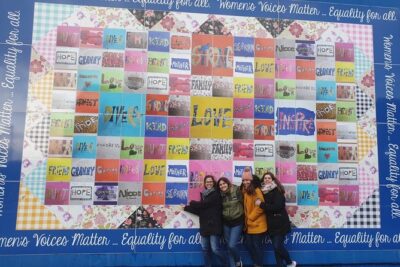
You have time to write your name and a message of hope on the wall. Bill Clinton and the Dalai Lama are among the notable people who have signed it. That small act can feel awkward if approached as a photo prop, so take a moment to consider what the wall represents before adding your message.
The stop lasts about 15 minutes. That gives you time to see the structure, listen to the explanation, and write something brief. It does not give you an extended walk through the surrounding neighborhoods. If you want a slower study of Belfast’s peace-building work, you will need another visit or a separate museum experience.
Still, this is one of the tour’s most useful features. You see the physical barrier, hear why it was built, and learn that the division has not vanished simply because open conflict has ended.
Clonard Monastery and the local Catholic story
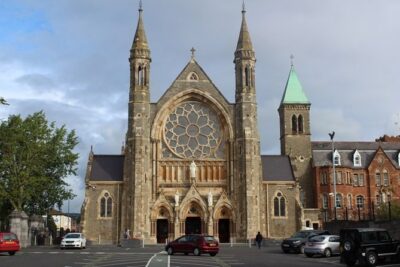
Clonard Monastery sits between the Falls Road area and the surrounding streets. Its architecture provides a sharp change from the painted political walls. The building was created with work by local craftsmen and Italians, and the tour allows about 10 minutes to see it.
The monastery helps place the neighborhood’s Catholic identity in a wider setting. It is not simply another quick photo stop. Its location, between communities shaped by conflict, gives it added meaning. Your driver can connect the building to the people and streets around it.
The short stop means you should not expect an architectural tour inside the monastery. You will see the exterior and hear its place in the neighborhood’s story. If you appreciate buildings as well as political history, this pause breaks up the mural-heavy route in a welcome way.
A few more Belfast half-days to weigh up
- From Belfast: Giant’s Causeway Full-Day Guided Trip
★ 4.8 · 6,361 reviews - Titanic Belfast Entrance Ticket: Titanic Visitor Experience Including SS Nomadic
★ 4.5 · 3,698 reviews - A History of Terror – Belfast City Centre Walking Tour
★ 5.0 · 2,883 reviews - Game of Thrones and Giant’s Causeway Full-Day Tour from Belfast
★ 5.0 · 2,291 reviews
Clonard Martyrs Memorial Garden and Bombay Street
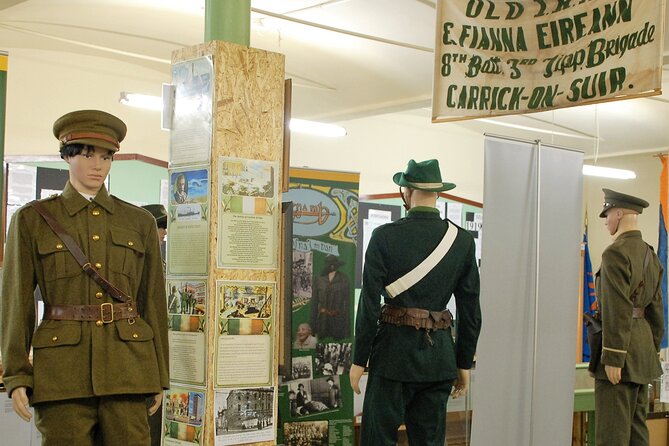
At the Clonard Martyrs Memorial Garden on Bombay Street, the focus turns to remembrance. The garden commemorates fallen volunteers from C Company, 2nd Battalion, Belfast Brigade, members of the republican movement, civilian casualties from Greater Clonard, and republican prisoners who died between 1916 and 1970.
The memorial was unveiled in 2000, with additional plaques added the following year for republican prisoners from the area who had died since 1916. An annual commemorative march is held around March 11. These details show how the memorial is linked to continuing community practices, not just to a finished chapter in a history book.
You have about 10 minutes here. That is enough to understand what the garden honors, but the names and political language may require patience. I recommend listening to the driver’s framing rather than forming a quick judgment from one plaque or symbol. The tour’s strength is its attempt to explain how one community remembers its dead.
St Peter’s Cathedral and a change of pace
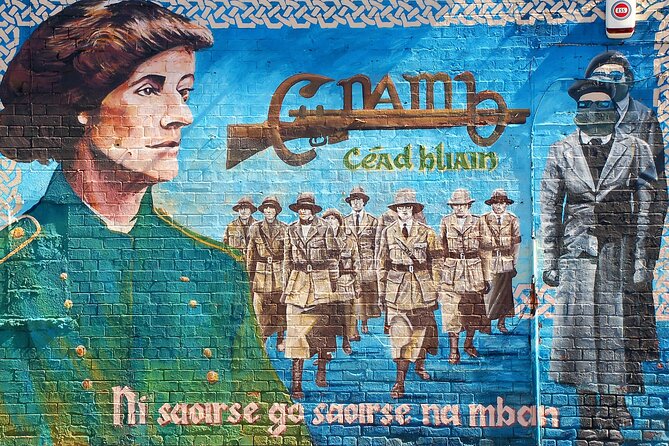
St Peter’s Cathedral offers another look at Belfast’s Catholic heritage. The building is known for its craftsmanship and dates to the 1800s. The tour also points out its connection to a well-known republican song written by a Catholic priest.
The information provided does not give a specific stop length, so treat this as a brief viewing rather than a full cathedral visit. It is an important pause because the tour is not only about conflict sites. Churches, streets, and community buildings help explain the culture that political murals often express in a more direct way.
If you are particularly interested in architecture, ask your driver to point out the details worth noticing before moving on. With only two hours, the visit will be focused rather than leisurely.
Bobby Sands mural and the Falls Road story
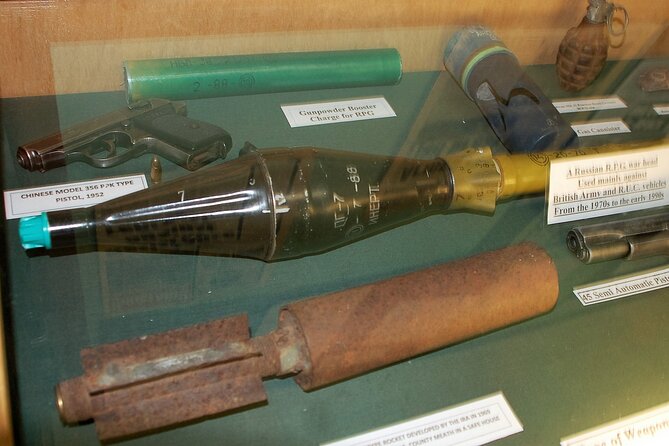
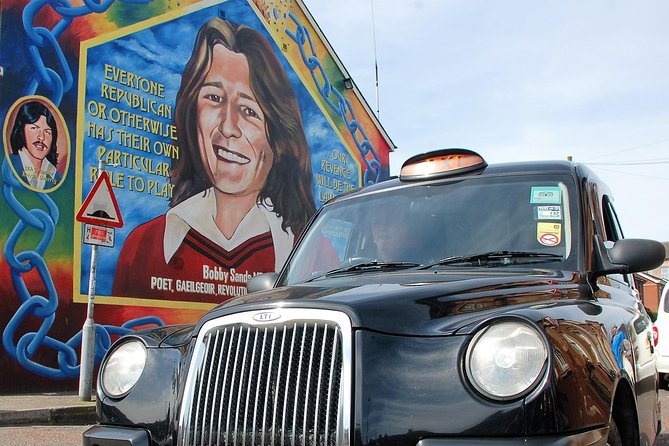
The Bobby Sands mural is one of the best-known images on the Falls Road. Bobby Sands was a member of the Provisional Irish Republican Army and died during a hunger strike in 1981. The stop gives your driver a chance to explain republican history, the role of the Falls Road, and the long path from earlier Irish conflicts toward the peace process.
The Falls Road is presented as the birthplace or central home of the Provisional IRA and the center of republicanism. That is a strong political statement, so listen for the local context behind it. The value of a private guide here is that you can ask how different groups viewed the same events.
You get around 15 minutes at the Bobby Sands mural. That should cover photographs and a focused explanation. It is also a good place to remember that murals can work in several ways at once: memorial, political message, community marker, and public history lesson.
The historic jail and the stories of imprisonment
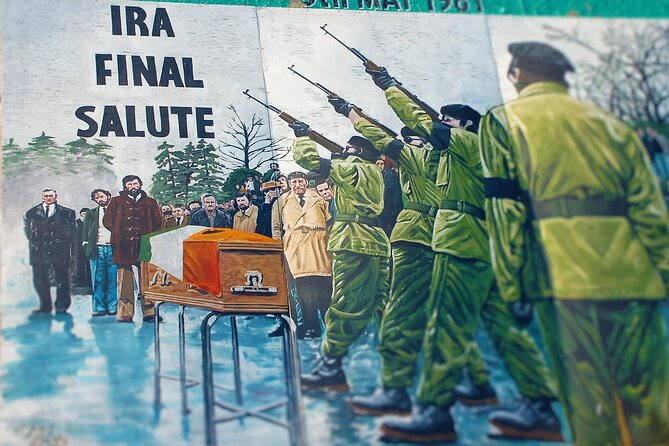
The route includes a historic jail that housed many famous prisoners and saw several successful escapes. It also served as a hanging jail into the 1960s.
The supplied details do not name the prison, so I would not book this tour expecting a full interior visit or a separate prison admission. Think of it as a passing point where the driver explains the role of imprisonment and execution in Belfast’s political story.
This stop adds useful context to the murals. The conflict was not only fought in streets and neighborhoods. Prisons became important places in the struggle, and the treatment of prisoners shaped public opinion on both sides.
Crossing to the Shankill Road
The move from the Falls Road to the Shankill Road is one of the tour’s clearest lessons. You are not simply changing streets. You are crossing from a mainly nationalist and republican area into a community associated with loyalism and support for the British crown.
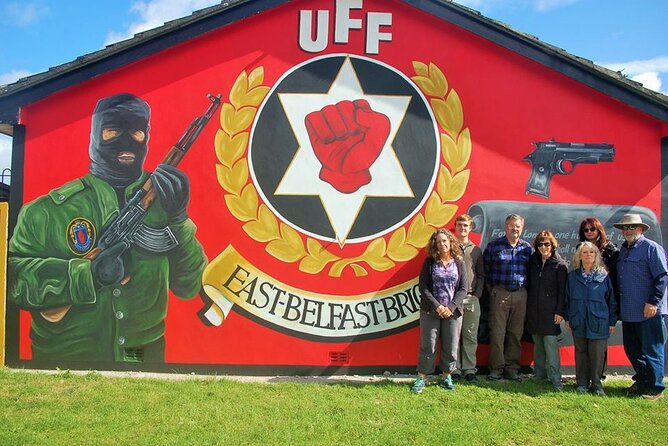
The Shankill Road has more than 500 years of history and is described as the birthplace of the UVF and UFF. Your driver explains the British history of Protestant communities and their opposition to republicanism. This part of the tour is important because it prevents Belfast’s story from becoming one-sided.
You have about 15 minutes here. The short time works well for a first orientation, though the political history is too broad to cover in detail. If you are comparing the Falls and Shankill murals, pay attention to symbols, flags, names, uniforms, and references to military service. The imagery reflects what each community values and remembers.
A balanced explanation matters most here. The tour is at its best when it helps you understand how two communities can live only a short distance apart while carrying very different memories of the same decades.
Shankill murals and the graveyard
The Shankill area provides more chances to photograph murals painted by local people in support of the crown. These works differ in subject and tone from the republican murals on the Falls Road, and seeing both sides in one trip is a major reason to choose this tour.
The Shankill Graveyard stop lasts about 15 minutes. It is another chance to see local memorial art and hear how loyalist identity is expressed publicly. The route does not treat the murals as isolated pieces of art. Instead, it connects them to neighborhood history and political belief.
You may find this part less comfortable than a standard city sightseeing stop. That is not a flaw, but it is something to accept before booking. The tour asks you to look at symbols connected to violence and loss without turning them into simple attractions.
What the two-hour format does well, and what it cannot do
Two hours is a useful first introduction. You cover Divis, Falls Road, Clonard, the International Wall, the Peace Wall, the Bobby Sands mural, the Shankill Road, and the Shankill Graveyard, with several shorter stops in between.
The private taxi keeps travel time efficient. You are not waiting for a large group to board a bus, and pickup and drop-off can be arranged within 1 kilometer of Belfast City Hall. That makes the tour especially useful near the start of a Belfast visit, when you want to get your bearings quickly.
The tradeoff is depth. Most stops last 10 or 15 minutes, and some important locations appear to be brief viewing points rather than full visits. You will leave with a framework, not a complete study of Northern Ireland’s political history.
At $116.69 per person, value depends heavily on group size. For one person, or a pair, the price is substantial for two hours. For a private group sharing the taxi, the cost can make more sense, particularly because you receive direct explanations and convenient central pickup rather than joining a larger vehicle.
The tour has a 4.9 rating from 67 reviews and is recommended by 97 percent of participants. More important than the numbers, the strongest praise focuses on two things: the driver’s courteous, balanced explanation and the operator’s flexibility when a cruise arrival changed because of bad weather. Those qualities matter on a tour dealing with painful history.
Pickup, meeting point, and practical details
Free pickup is available within a 1 kilometer radius of Belfast City Hall. If you are arriving by cruise ship, direct pickup is not offered. A free Visit Belfast shuttle bus runs to the City Hall pickup point, so allow enough time to make that connection.
Airport, train station, cruise ship, and Airbnb pickup may involve a surcharge paid in cash on the day. The supplied information is clear that those pickup options are not included in the main price. Confirm the exact arrangement before setting off, especially if you are arriving with luggage or on a tight schedule.
The tour is offered in English, and you receive confirmation when booking. Children must be accompanied by an adult. Service animals are allowed, most people can participate, and public transportation is nearby.
You can cancel for a full refund up to 24 hours before the start time. Changes made inside that 24-hour window are not accepted, and a minimum number of participants is required for the experience to operate. If the operator cancels for that reason, you are offered another date or experience, or a full refund.
Who should book this Belfast taxi tour?
I would choose this tour if you want a direct introduction to The Troubles and prefer local streets to a long museum visit. It suits first-time visitors, history-minded families with older children, and anyone who wants to compare nationalist and loyalist neighborhoods in one compact trip.
It also works well for cruise passengers, provided you use the Visit Belfast shuttle to City Hall and leave a sensible time margin. The private format is useful if you have questions or want a quieter setting for a serious subject.
I would think twice if you want extensive time inside buildings, a relaxed architecture tour, or a full academic account of Northern Ireland’s political past. The route moves quickly, and the subject matter can feel heavy. You need to be comfortable listening more than talking, especially at memorials and around politically charged symbols.
Should you book it?
Book this Belfast black taxi tour if you want context, local streets, and both sides of the city’s political story in two hours. The Peace Wall, murals, Falls Road, and Shankill Road are far more meaningful when a local driver explains the people and events behind them.
Skip it if you want a light city tour or dislike emotionally difficult history. For a private group, the price can be fair, and the central pickup makes it easy to fit into a Belfast day. For solo visitors, it is a bigger expense, but the focused route and personal setting may still justify it.
FAQ
How long is the Belfast black taxi tour?
The tour lasts approximately two hours.
What does the tour focus on?
It focuses on Belfast’s political murals, the Peace Wall, the Falls Road, the Shankill Road, memorials, churches, imprisonment, and the history of The Troubles.
Is this a private tour?
Yes. Only your group participates in the activity.
Is pickup available from Belfast City Hall?
Yes. Free pickup is offered within a 1 kilometer radius of Belfast City Hall.
Can the tour pick me up directly from a cruise ship?
No. Direct cruise ship pickup is not offered. A free Visit Belfast shuttle bus can take you to the City Hall pickup point.
Are airport, train station, cruise port, and Airbnb pickups included?
No. These pickup options involve a surcharge paid in cash on the day.
Is the tour offered in English?
Yes. The tour is offered in English.
Can children join the tour?
Yes, but children must be accompanied by an adult.
Can I cancel for a full refund?
Yes. You can cancel at least 24 hours before the local start time for a full refund. Cancellations or changes made less than 24 hours before the start time are not refunded or accepted.
Just added around Belfast
- Belfast history of terror & mural 1 hr express private taxi tour★ 5.0 · 3 reviews
- Game of Thrones scene location inc Giants causeway from Belfast★ 5.0 · 3 reviews
- Experience the Antrim Coast and the Land of Giants – Private Tour★ 5.0 · 3 reviews
- Giants Causeway Tour From Belfast including Game of thrones sites★ 5.0 · 3 reviews
- Belfast to Dublin Transfer★ 5.0 · 3 reviews
- Private Coast Tour in Belfast★ 5.0 · 3 reviews
- Belfast & Giants Causeway Luxury Mercedes Private Tour for 6 pax★ 5.0 · 3 reviews
- Belfast City Airport (BHD) to Belfast Accommodation – Arrival Private Transfer★ 5.0 · 3 reviews
Belfast Black Taxi & Mural Tours, compared.
Cab Tours Belfast Famous Black Taxi Tours
See the full review →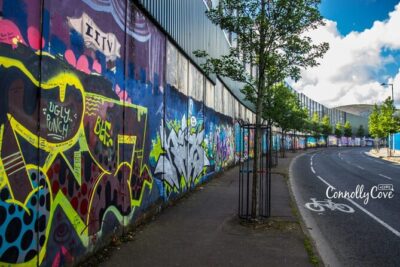
Browse the lists this tour appears in