
Reviewed · BELFAST BLACK TAXI & MURAL TOURS
IRA Troubles Conflict Private Tour Museum Graves Murals and Political Analysis
Belfast’s past is not locked in a museum. It is painted on gable walls, marked by cemetery graves, and divided by gates that still close at night. This private tour takes you into Falls Road, Shankill Road, Milltown Cemetery, and several Republican memorials while explaining The Troubles from an Irish Republican perspective.
I like the access to the Eileen Hickey Irish Republican History Museum, which is not normally open to the public, and the freedom to ask questions in a private vehicle. Guides such as Barry, Paula, and Joe bring personal experience and local detail. The main drawback is clear: this is not a neutral, two-sided political tour, so you should choose it only if you want the Republican viewpoint.
Key points to know before booking
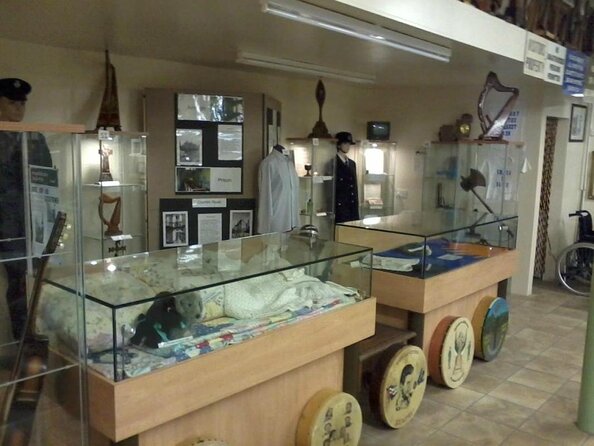
- Private museum access: Visit the Eileen Hickey Irish Republican History Museum when it is open, Tuesday through Saturday from 10 a.m. to 2 p.m.
- A Republican point of view: The tour explains the conflict through Irish nationalism, Republican resistance, prisoners, hunger strikes, and the peace process.
- Important Belfast locations: See Falls Road, Shankill Road, Divis Tower, Ballymurphy, Clonard, and the city’s Peace Walls.
- Powerful memorial sites: Walk through the Republican Plot at Milltown Cemetery and visit the Bobby Sands memorial area.
- Personal and flexible guiding: Barry, Paula, Joe, Brendan, Ciarán, and other local guides may lead the tour, with room for questions and changes along the way.
- Hotel pickup has limits: Free pickup is offered from the Leonardo hotel meeting point. Other central locations, cruise ships, and some sights cost extra.
Why this Belfast tour feels different
Many Belfast tours give you a quick look at a mural, a Peace Wall, and the famous black taxi routes. This one spends more time inside the Republican story. You hear how the guide’s interpretation connects centuries of Irish-British conflict with the events that began in 1969, the IRA campaign, the hunger strikes, and Northern Ireland’s current political situation.
That approach can be powerful. The tour does not treat the murals as simple street art. You are asked to read them as political statements, memorials, and signs of communities that still define themselves through memory. At the same time, you need to listen with care. The stated focus is Republican history, and one of the tour’s own responses to criticism makes clear that loyalist and British arguments are not given equal weight.
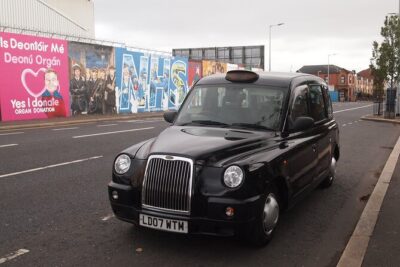
The private format helps. You travel in an air-conditioned vehicle with only your own group, so you can stop to ask about a name, a date, or a symbol. Guides have also adjusted stops during the tour when conversation moved in a useful direction. That is a real advantage over a large coach tour, where the schedule and script usually leave little room for follow-up questions.
Other black taxi and mural tours:
- Cab Tours Belfast Famous Black Taxi Tours
★ 5.0 · 3,633 reviews - Private Black Taxi Belfast City Tour
★ 5.0 · 2,188 reviews - Belfast’s Political Mural Taxi Tour
★ 5.0 · 1,180 reviews
Falls Road and the International Mural Wall
The tour begins around Divis Street and the Falls Road, in the heart of Republican west Belfast. Your guide sets out the background to The Troubles and explains how Nationalist and Unionist communities came to live behind barriers and controlled routes.
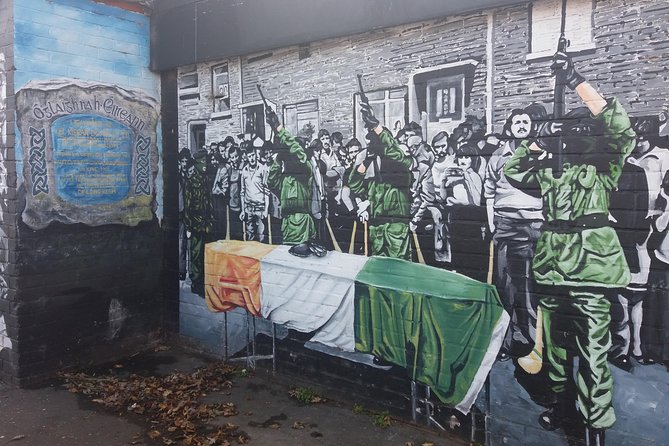
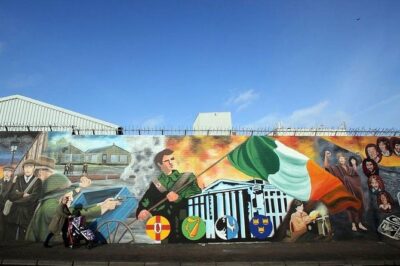
The International Mural Wall is a good first stop because it shows how Belfast’s murals connect local events with wider political struggles. You will see work associated with Republican politics and former prisoners, along with themes of solidarity and resistance. Admission is included, and the stop takes about ten minutes.
I would use this opening to ask your guide about the language used on the murals. Terms such as Republican, Nationalist, Loyalist, and Unionist carry specific political meanings in Northern Ireland. A short explanation early in the tour makes the later memorials easier to understand.
The Peace Walls from both sides
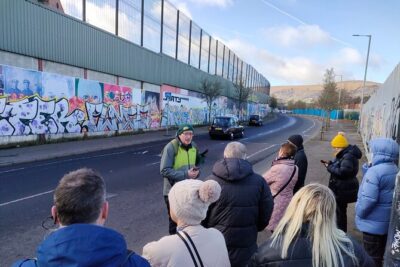
The Peace Walls are not a single monument. They are a network of barriers separating mainly Catholic Republican or Nationalist areas from mainly Protestant Loyalist or Unionist areas. The tour visits both sides of a wall and explains why it was built.
The barriers began appearing after sectarian riots in 1969. They were meant to be temporary, but they remained because they reduced the risk of attacks between neighboring districts. Some walls became longer and more imposing over time, and about one-third were built after the IRA ceasefire in 1994.
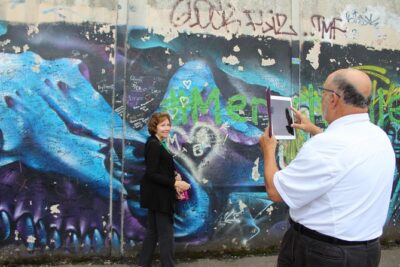
You can sign your name and write a message of peace. That small act gives the stop a personal edge, but do not mistake the colorful messages for proof that the divide has vanished. The tour points out that some gates still close at night, and communities remain separated in daily life.
The best-known wall lies between the Falls Road and Shankill Road. It runs for roughly 800 meters and forms a high, concrete boundary through an area where tensions existed long before The Troubles. You will see it up close and also pass the biggest Peace Wall in Belfast later in the drive.
Shankill Road and the Loyalist story
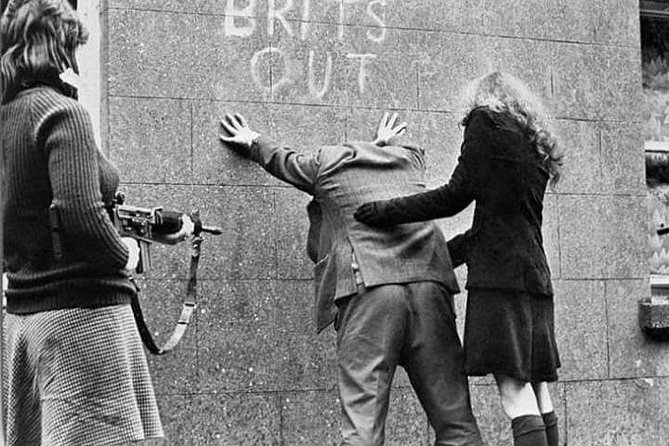
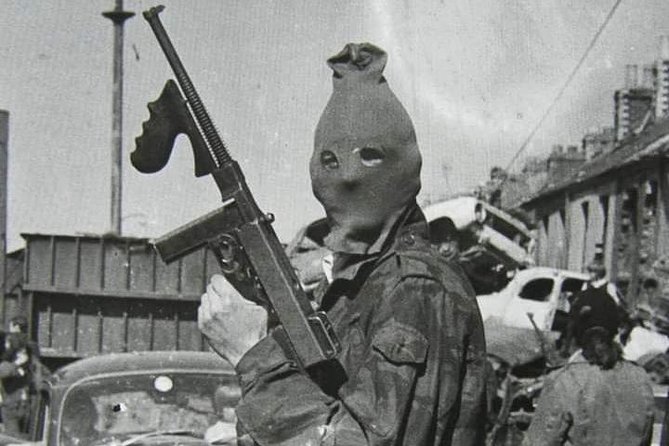
Shankill Road is the center of Ulster Loyalism, and its murals present a very different political message from those on Falls Road. You will see images linked to Loyalist paramilitary groups including the UDA, UFF, and UVF, often showing masked men and weapons.
The guide explains how Loyalism developed and how these groups operated during the conflict. This is one of the tour’s most important stops, even though the overall interpretation remains Republican. You get to see the physical closeness of the two communities and the very different memories displayed on each side.
I would not expect a full, even-handed account of Loyalist political arguments here. If you want an equal treatment of Republican, Loyalist, and British positions, the company also offers a separate Belfast taxi tour described as balanced. This experience is better for understanding the Republican reading of events and the places that shaped it.
More museums in Belfast:
- Belfast Titanic Museum and Sighseeing Tour
★ 4.5 · 59 reviews - Titanic Museum and Whiskey Distillery Exploration with Tasting
★ 4.5 · 25 reviews - Belfast City Sightseeing Tour Including Titanic Museum | 6 Hours
★ 4.5 · 9 reviews - Saint Patrick Centre Exhibition experience
★ 4.5 · 33 reviews
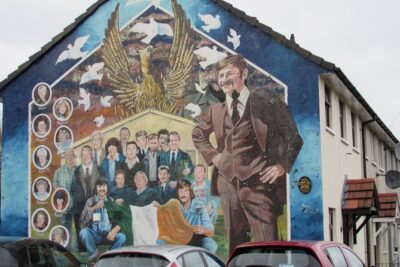
Clonard Martyrs Memorial Garden
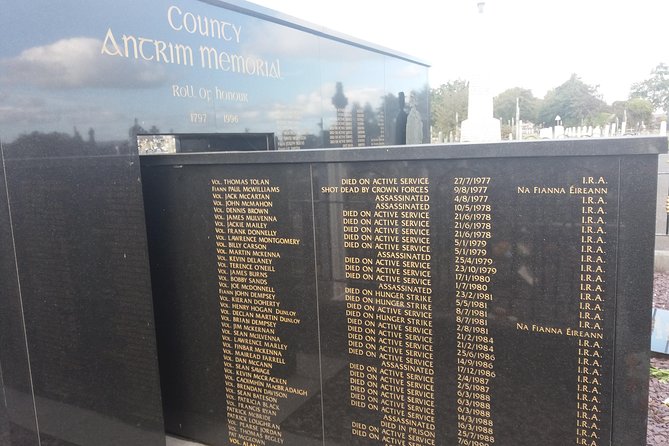
At Bombay Street in Clonard, the tour visits a memorial garden dedicated to Republican volunteers, civilians, and Republican prisoners from the area. Its setting matters. Bombay Street was badly affected by the loyalist attacks of August 1969, when Catholic residents were driven from their homes and houses were burned.
The garden is filled with symbols and names. A black and red iron phoenix at the gate represents the idea that the Provisionals rose from the ashes. Inside are Celtic crosses, plaques, lists of fallen volunteers, and memorials to civilians killed by Loyalists and British forces, as the inscriptions describe them.
The site is divided into three yards. One section honors C Company of the 2nd Battalion, Belfast Brigade, while another remembers Republican prisoners who died across different decades. Benches carry small dedication plaques, and the Irish-language signs add to the sense that this is a living community memorial rather than a tourist display.
You may find this stop emotionally heavy. The memorial presents one community’s grief and pride, not a complete record of every victim or political argument. Your guide’s commentary is important here, since the names and symbols can be difficult to interpret on your own.
Milltown Cemetery and Bobby Sands
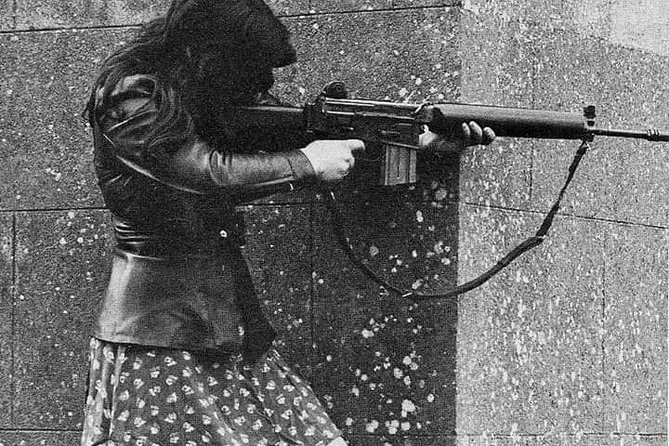
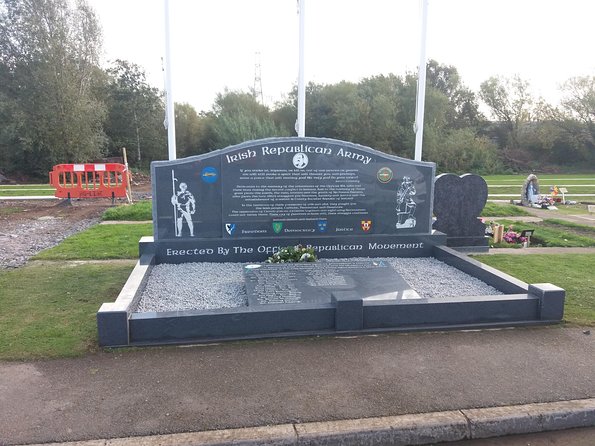
Milltown Cemetery contains several Republican plots, including graves cared for by the National Graves Association in Belfast. The tour visits the New Republican Plot and the resting place of Bobby Sands, the IRA member who died on hunger strike in 1981 while imprisoned at the Maze.
Sands had been elected as a Member of Parliament when he died after 66 days without food. His death became a defining moment in the conflict, and the cemetery visit gives you a quiet place to consider the human cost behind the political arguments.
The Republican plots also include IRA volunteers killed in the 1920s, during the Northern Campaign of the 1940s, and in later periods. Graves are marked with the Red Hand, and the New Republican Plot contains the remains of 77 IRA volunteers, including Máiread Farrell.
The cemetery is allocated about 25 minutes, longer than most individual stops. That makes sense if you want to study the names and ask questions, but one visitor felt too much time was spent there. If you have a family grave to visit, the guide may be able to help with practical arrangements. One guide even stopped at a flower shop for a couple who wanted to leave flowers.
Bobby Sands murals and the hunger strikes
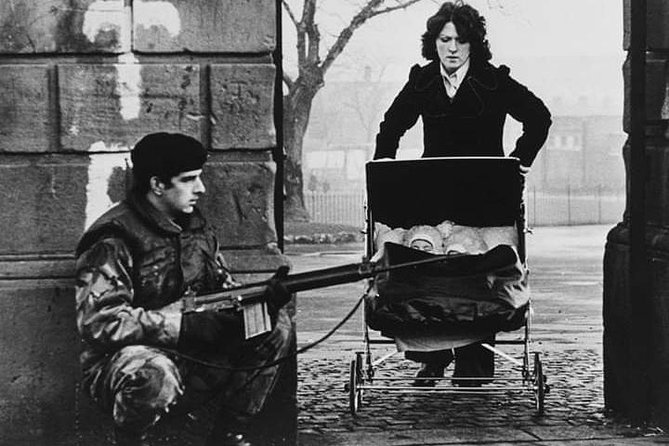
The tour includes more than one Bobby Sands mural, so do not confuse the stops. One focuses on the iconic portrait mural and explains the Blanket Protest, Dirty Protest, and hunger strikes of 1981. Another brings you to the Republican heartland and the 2nd Battalion IRA Garden of Remembrance, also known as D Company or The Dogs.
You will also see photographs connected with 12 of the 22 hunger strikers. The guide explains how Republican prisoners protested the removal of Special Category Status, which had allowed them to be treated as political prisoners rather than ordinary criminals.
These stops work best if you have already read a little about the hunger strikes. The subjects are complex, and the tour moves quickly. Ask your guide to explain the difference between the prison protests, the electoral campaign around Sands, and the wider Republican strategy.
The Eileen Hickey Irish Republican History Museum
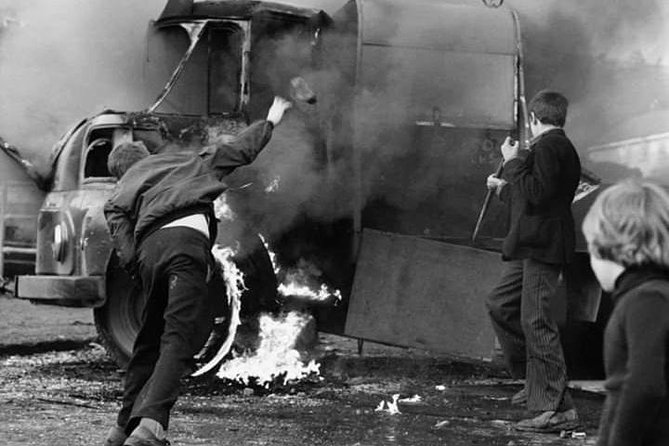
The private museum is one of the tour’s biggest selling points. It is not usually open to the public, and the guide presents material about Irish resistance, the IRA, Republican prisoners, and the long struggle against British rule in Ireland.
You may meet former prisoners who share personal experiences of the conflict. The tour also includes the chance to see and handle plastic and rubber bullets used by British Crown forces. That kind of object can make the era feel immediate in a way that a mural cannot.
The museum is open only from 10 a.m. to 2 p.m., Tuesday through Saturday. If it is closed, the alternative is a tour around Ballymurphy. Check the timing when you book, especially if the museum is your main reason for choosing this experience.
The museum is not presented as a neutral national archive. It is a Republican collection, and the material reflects that purpose. I would treat it as a valuable primary viewpoint, then compare it with other sources if you want a fuller picture of the conflict.
Clonard Monastery and the peace effort
Clonard Monastery sits near the interface between Falls Road and Shankill Road. During the violence that began in 1969, priests from the monastery worked to protect local residents and help create contact between divided communities.
The monastery was home to Father Alec Reid and Father Gerry Reynolds, two priests associated with peace work. Their role gives this stop a different tone from the IRA memorials and paramilitary murals. It shows that the story of Belfast also includes quiet negotiation, religious leadership, and people trying to reduce violence from within the communities most affected.
The stop takes about ten minutes. You may not spend long inside the church or monastery itself, but the location helps explain why this patch of west Belfast became such an important front line.
Divis Tower, Ballymurphy, and local memorials
Divis Tower overlooks the Falls Road and was used by the British Army as a sniper position and observation post until 2005, according to the tour description. You will see murals and names connected with the first two victims of The Troubles.
The drive continues through Ballymurphy, where murals remember local volunteers and the Great Famine. One mural refers to Jim Bryson and his Big Louie machine gun, linking local Republican memory with armed resistance during the conflict.
You will also pass Divis, described as the heartland of the Irish Republican Army, with its Welcome Wall and additional memorial artwork. These short stops are mainly for viewing and photographs, but they fill in the neighborhood context that a single mural visit cannot provide.
Timing, transport, and what the price covers
The tour lasts about three hours and costs $255.50 per person. That is a serious price for a short city tour, but it includes private transportation, an air-conditioned vehicle, hotel transfer from the central meeting point, museum access when available, and a highly focused route through west Belfast.
The value improves if you are traveling as a small private group. You are not paying simply for a drive past murals. You are paying for a local guide, direct conversation, a flexible schedule, and access to places that are not part of every Belfast tour. If your main goal is a quick photo at the Peace Wall, a cheaper group tour may be enough.
Pickup is free from the Leonardo hotel meeting location. Extra charges apply for many other locations, including some central attractions, Lanyon train station, St George’s Market, Titanic Belfast, Crumlin Road Gaol, Queen’s University, the Botanical Gardens, and the Ulster Museum. Cruise ship pickup costs $25 each way, and airports are not served.
You can request an upgrade to a luxury Mercedes-Benz V-Class with electric doors, leather reclining seats, and privacy glass for £25 when available. That is optional, not part of the standard experience.
Which guide might you have?
The company uses several guides, so you may be led by Barry, Paula, Joe, Brendan, Ciarán, or another member of the team. Barry is repeatedly praised for tailoring the route, explaining events from ancient Irish history through the present, and sharing reading and film suggestions for after the tour.
Paula is described as warm, flexible, and strong at connecting personal stories to the places you visit. Joe’s first-hand experiences are a central part of his guiding style, while Brendan and Ciarán are also noted for personal insight and a friendly manner. Ciarán’s white taxi and local connections added a sense of welcome for one solo participant.
Personal experience can make the tour vivid, but it can also make the presentation strongly opinionated. Accents may be difficult for some people to follow, and one visitor found this a problem with a guide named Anton. If hearing every detail matters to you, ask questions, request a slower pace, and confirm names and dates as you go.
Who should book this experience?
I would choose this tour if you want:
- A focused Republican account of The Troubles
- Access to memorials and a private collection
- Time to ask detailed questions
- A personal guide rather than a fixed group script
- A route through Falls Road, Shankill Road, Clonard, Ballymurphy, and Milltown Cemetery
- A serious look at how Belfast remains divided after the ceasefires
I would choose another tour if you want a fully balanced account of both communities, a broad Belfast sightseeing route, or a lighter introduction to the city. The memorials, graves, hunger strikes, and stories of violence require attention and respect. This is not a casual mural photo drive.
Free cancellation is available up to 24 hours before the start time. Most participants can take part, and confirmation is provided at booking.
Should you book the IRA Troubles Conflict Private Tour?
Book it if you want to understand Belfast through the Republican experience and are ready to face difficult subjects. The private museum, Milltown Cemetery, Clonard memorials, and first-hand guiding give the tour a level of access that many standard city tours cannot match.
Do not book it expecting a neutral debate. The route includes Loyalist places, but the explanation is framed around Irish Republican history. For the clearest decision, ask yourself one question: do I want to hear a particular community’s memory of The Troubles in the places where it happened? If the answer is yes, this can be one of the most meaningful three hours you spend in Belfast.
FAQ
How long does the tour last?
The tour lasts approximately three hours.
How much does the tour cost?
The listed price is $255.50 per person.
What viewpoint does the tour present?
The tour presents The Troubles and Irish history primarily from an Irish Republican perspective. It discusses Loyalist and British involvement within that framework.
Is the museum open every day?
No. The Eileen Hickey Irish Republican History Museum is open only from 10 a.m. to 2 p.m., Tuesday through Saturday. If it is closed, the tour includes Ballymurphy instead.
Where is free pickup available?
Free pickup is offered from the Leonardo hotel in central Belfast. Other pickup points may involve an extra charge.
Can cruise ship passengers book pickup?
Yes. Cruise ship pickup costs $25 each way and is paid directly to the guide by cash or card.
What is the cancellation policy?
You can cancel at least 24 hours before the start time for a full refund. Cancellations or changes made less than 24 hours before the start time are not accepted for a refund.
Just added around Belfast
- Belfast history of terror & mural 1 hr express private taxi tour★ 5.0 · 3 reviews
- Game of Thrones scene location inc Giants causeway from Belfast★ 5.0 · 3 reviews
- Giants Causeway Tour From Belfast including Game of thrones sites★ 5.0 · 3 reviews
- Experience the Antrim Coast and the Land of Giants – Private Tour★ 5.0 · 3 reviews
- Belfast & Giants Causeway Luxury Mercedes Private Tour for 6 pax★ 5.0 · 3 reviews
- Belfast to Dublin Transfer★ 5.0 · 3 reviews
- Private Coast Tour in Belfast★ 5.0 · 3 reviews
- Belfast Private Walking Tour with a Local★ 3.0 · 3 reviews
Belfast Black Taxi & Mural Tours, compared.
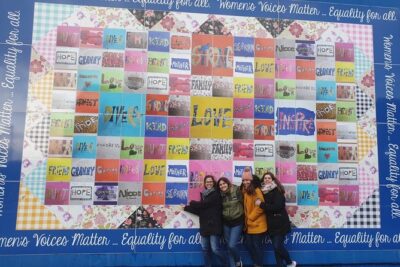
Cab Tours Belfast Famous Black Taxi Tours
See the full review →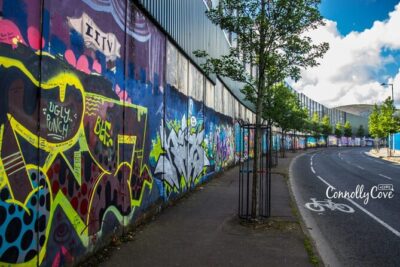
Browse the lists this tour appears in