
Reviewed · BELFAST BLACK TAXI & MURAL TOURS
Belfast Troubles Tour: Walls and Bridges
The most useful thing about the Belfast Troubles Tour: Walls and Bridges is that it does not treat the conflict as a quick photo stop at a wall. You walk through central Belfast, visit divided neighborhoods, hear personal memories, and place the Troubles within the city’s longer story.
I like the native guide approach, especially when Arthur or Steve is leading. I also like the balance between difficult political history and ordinary Belfast life, from pubs and music to industry, architecture, and the city’s hopes for the future. The drawback is clear: this is a serious tour with graphic content, and nearly three hours of walking can feel long if you want a light sightseeing outing.
Key points to know before you book
- Personal accounts from Belfast guides: Arthur and Steve bring lived experience and local perspective to a complicated subject.
- The Peace Wall is only one part: You also visit City Hall, murals, the Albert Clock, Cathedral Quarter, historic entries, and a remarkable Presbyterian church.
- A walking tour gives useful context: You see how the city’s neighborhoods and landmarks connect rather than viewing the conflict through a coach window.
- Expect frank discussion: The tour covers violence, discrimination, politics, religion, and graphic events. It is intended for ages 14 and older.
- Private format with a small maximum: A private guide is included, with a maximum of 16 people and personal attention throughout.
- Good central location: The route starts at City Hall and finishes near Rosemary Street, close to where you began.
Belfast City Hall sets the tone
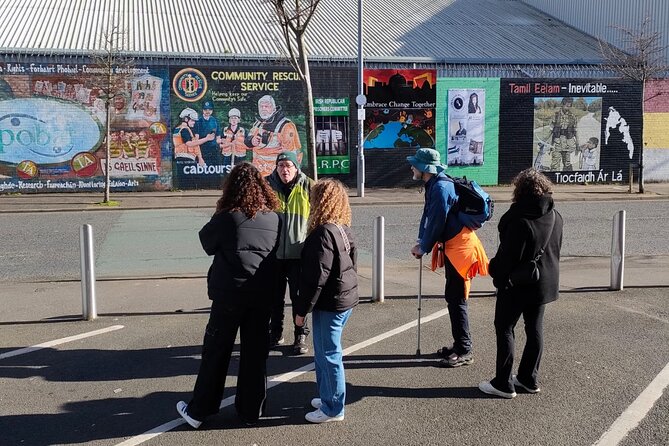
The tour begins at Belfast City Hall, an imposing landmark in the center of town. Its dome rises 174 feet, and the interior uses several types of Italian marble, Cippolino marble from Greece, and large stained-glass windows.
You get about ten minutes here, enough to understand why the building matters before the tour moves into harder subject matter. City Hall is more than a grand civic building. It represents Belfast’s industrial wealth and civic ambitions, which helps explain the city you are about to walk through.
The opening is useful because the tour does not begin with a wall or a tragedy. You first get a sense of Belfast as a major city with a proud public face. That wider frame matters. The Troubles did not happen in a place without culture, business, politics, or ordinary daily life.
Near City Hall, the route also includes the Big Fish and the Albert Memorial Clock. The Big Fish is a modern sculpture by Dan George, built around a traditional Celtic design and linked to Belfast’s engineering, industry, and communities. It gives you a lighter architectural moment before the walking becomes more political.
Other black taxi and mural tours:
- Cab Tours Belfast Famous Black Taxi Tours
★ 5.0 · 3,633 reviews - Private Black Taxi Belfast City Tour
★ 5.0 · 2,188 reviews - Belfast’s Political Mural Taxi Tour
★ 5.0 · 1,180 reviews
Murals on Divis Street explain the public argument
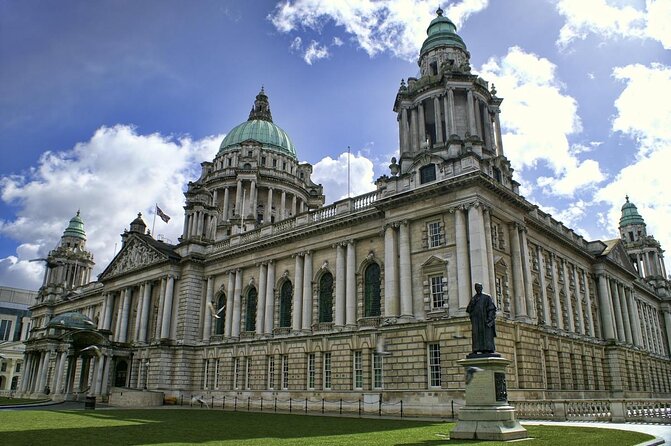
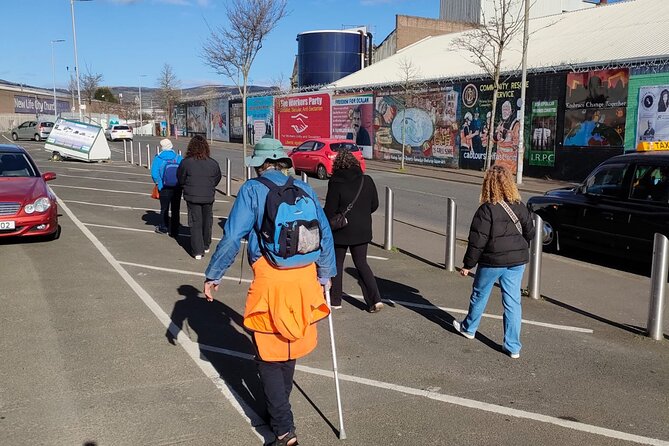
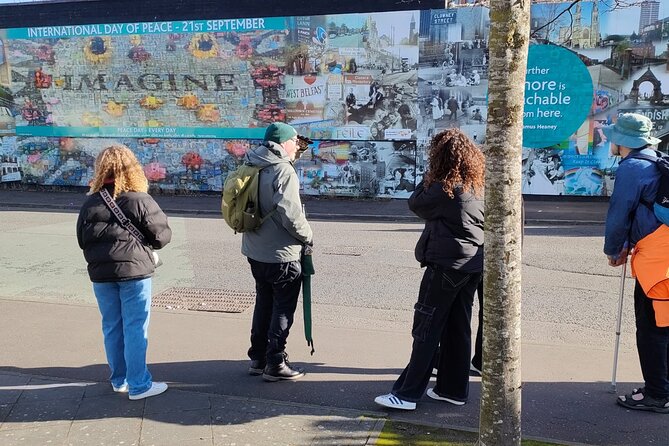
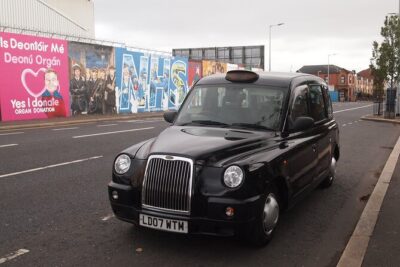
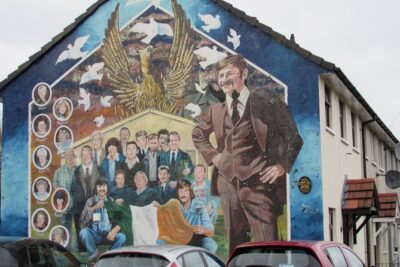
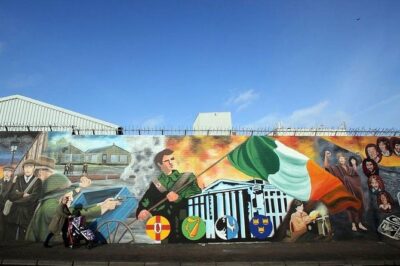
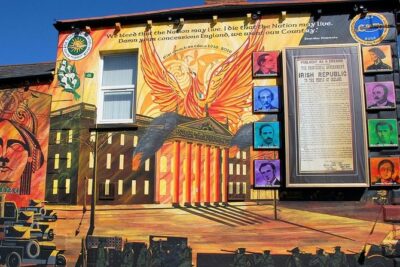
The International Mural Wall near Divis Street offers an early look at how Belfast’s walls became a form of communication. These murals have served as public media, carrying political messages, cultural identity, and views from beyond Northern Ireland.
You will not simply be shown painted walls and sent on your way. The guide explains why murals matter and how public space became part of the argument between communities. This is one reason I prefer the walking format here. You can stop, look closely, and ask a question instead of trying to absorb everything through a vehicle window.
The mural section can also help you avoid a common mistake: assuming every Belfast mural tells the same story. The city’s visual language is political, local, and sometimes confrontational. Listen for the distinctions between unionist and nationalist communities, and keep an open mind when the guide explains how symbols can mean very different things to different people.
The Peace Wall is powerful, but not the whole story
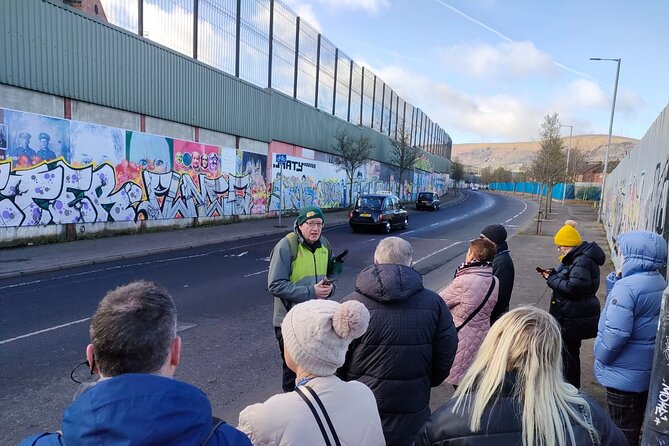
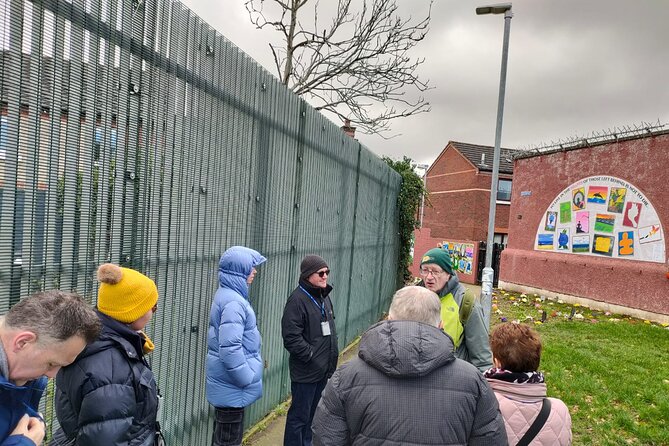
The Peace Wall is the emotional center of the route for many people. These barriers divide communities and rise about 16 metres, with mesh along the top designed to stop petrol bombs. You have around 15 minutes to examine the wall, take photographs, and hear detailed explanations.
The physical scale is striking. A wall that high makes the idea of separation feel immediate rather than abstract. At the same time, the tour gives you more than a dramatic photograph. It explains the fear and mistrust that made such barriers part of daily life.
This stop deserves respect. It is not a theme-park attraction, and the personal stories can be difficult. The guide may use humor across the tour, but the humor works best as a way to help you listen, not as a way to make the subject harmless.
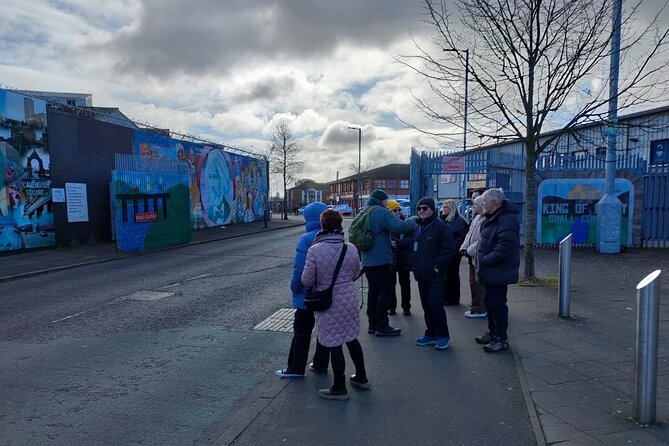
The name Walls and Bridges points to the tour’s central idea. Walls refer both to the physical barriers in Belfast and to the divisions people create between one another. Bridges refer to efforts to build understanding. The tour is not presented as a simple contest with one side entirely right and the other entirely wrong.
That balance is one of the strongest features of the experience. The political and religious divisions are explained directly, but the guide also asks you to examine your own assumptions. You leave with a clearer sense of how labels and inherited prejudice can shape a place for decades.
The Albert Clock links Belfast to its older center
The Albert Memorial Clock gives the walk a change of pace. Belfast’s own leaning tower rises 113 feet and leans about four feet from the perpendicular. It was built at the point where the crossing that helped establish Belfast as a town once stood.
You spend only about five minutes here, but the stop is well chosen. The clock connects the modern city to its older commercial core and shows that Belfast has plenty of memorable architecture beyond its political murals.
The clock also has a statue of Prince Albert and appeared in the film noir Odd Man Out, starring James Mason. You do not need to be a film expert to enjoy the detail, but it adds another layer to a landmark that could otherwise become just a quick photograph.
A few more Belfast half-days to weigh up
- From Belfast: Giant’s Causeway Full-Day Guided Trip
★ 4.8 · 6,361 reviews - Titanic Belfast Entrance Ticket: Titanic Visitor Experience Including SS Nomadic
★ 4.5 · 3,698 reviews - A History of Terror – Belfast City Centre Walking Tour
★ 5.0 · 2,883 reviews - Game of Thrones and Giant’s Causeway Full-Day Tour from Belfast
★ 5.0 · 2,291 reviews
Cathedral Quarter shows the city beyond conflict
The route then reaches the Cathedral Quarter, now one of Belfast’s main social and cultural areas. You walk past colorful murals, old entries, pubs, restaurants, and cobbled streets that recall earlier Belfast.
This is an important part of the tour because it widens the subject. Belfast is not only a city of barriers and political memory. It is also a place of music, nightlife, food, and changing neighborhoods.
You get about ten minutes here, so do not expect a full restaurant or pub crawl. Instead, use the stop to see how old lanes and newer cultural life sit together. The guide also points out places connected with major rock events, giving the area a link to Belfast’s music story.
I like this section because it prevents the tour from becoming emotionally one-note. After the Peace Wall, a walk through the Cathedral Quarter gives you room to consider the city as it is now, not only as it was during the worst years of the Troubles.
Belfast Entries reveal the city’s older passages
The Belfast Entries are historic passageways that are easy to miss if you do not know where to look. The tour meanders through them, passing places connected with revolution, intrigue, and pubs.
This is where a local guide earns the fee. A standard city walk might keep you on the main streets, but these narrow routes show how Belfast’s older street pattern survives behind the modern center. The passages also make the history feel closer to street level.
You get about ten minutes in this area. That is enough to see the character of the lanes and hear the stories, though anyone wanting a long architectural study will find the stop brief. The real value is the connection between small physical spaces and the larger political history being discussed.
First Presbyterian Church ends on a surprising note
The final major stop is First Presbyterian Church on Rosemary Street, only about five minutes from the starting point. Dating from 1783, the church has an elliptical interior and a strong connection to Irish political and religious history.
John Wesley preached from its pulpit and admired the building’s shape. Its members also took important positions in support of civil and religious freedoms. That history complicates the usual picture of Belfast as a city defined by a simple Protestant and Catholic divide.
You have around ten minutes to enter, look around, and take photographs. This is a fitting ending because it shifts the focus from separation toward the possibility of shared civic values.
The church is also practical as a finish. You end in the center rather than at a distant neighborhood, within sight of City Hall. The stated end point is Rosemary Street at First Presbyterian Church, Belfast BT1 1QB.
What the guide adds to the experience
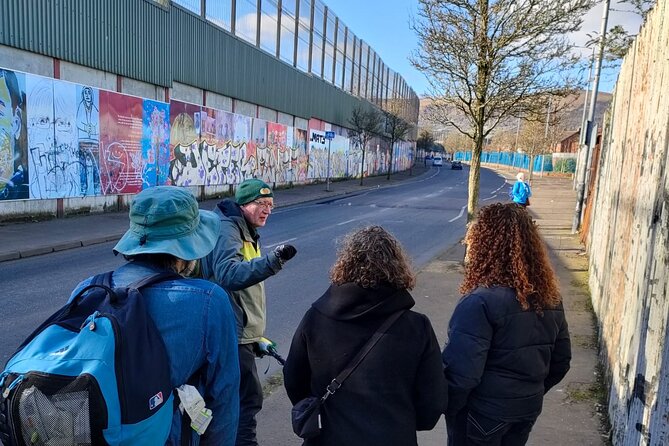
The guide is the main reason to choose this tour instead of reading about the Peace Wall on your own. Arthur McGee is repeatedly singled out for his humor, directness, storytelling, and personal connection to the period. Steve is also praised for combining historical explanation with personal stories from Belfast.
You should not expect a neutral tone in the sense of a dry textbook. You get a human presentation of history, including personal memories and strong feeling. At the same time, the guide aims to explain both unionist and nationalist neighborhoods and to avoid reducing the conflict to a slogan.
Headsets may be provided so you can hear the guide clearly while walking. That helps in a city center where traffic, conversation, and street noise can interfere. It also means the guide can keep speaking while the group moves instead of gathering everyone into a tight circle at every corner.
The humor is another useful part of the pacing. Three hours is a long time to listen to painful material, and well-timed humor gives you a moment to breathe. The subject remains serious, but the presentation does not become a grim lecture from start to finish.
How much walking and time to allow
The experience lasts about two hours and 40 minutes to three hours. One review describes a longer outing, but the stated tour length is three hours, and the guide has clarified that this is the intended duration.
You need a moderate level of physical fitness. This is a walking tour through city streets, with several stops and enough movement between them to make comfortable shoes sensible. The exact pace may vary with questions and group size.
The maximum is 16 people, and the tour is described as private. That combination suggests a more personal outing than a large scheduled group, with room for questions and direct conversation. If you are booking for a couple, family, or small group, the private format can make the price easier to justify.
The route begins at Belfast City Hall, BT1 5GS. It finishes at First Presbyterian Church on Rosemary Street, near the starting point. Public transportation is nearby, so you do not need a car to reach the tour.
Is $33.29 a fair price?
At $33.29 per person, this is not the cheapest way to walk around Belfast, but the price compares well with the amount of guide time involved. You get close to three hours, a professional local guide, a private tour format, and access to First Presbyterian Church.
The key value is interpretation. You can photograph the Peace Wall for free, and you can walk past City Hall, the clock, the Cathedral Quarter, and the entries without paying an admission fee. What you cannot easily recreate is the sequence of explanations connecting those places to Belfast’s political, social, and cultural story.
If you are mainly seeking a quick list of landmarks, the price may feel high. If you want to understand why the city looks and feels as it does, the cost is reasonable, especially for a small private group.
The tour is booked about 18 days ahead on average, which is a useful sign that you should not leave it until the last day of a short Belfast visit. Confirmation is provided at booking. Free cancellation is available up to 24 hours before the start time, but changes or cancellations inside that window are not refunded.
Who should book this Belfast walk?
I would choose this tour if you want history explained by someone from Belfast rather than presented as a short scripted overview. It suits adults, older teenagers, students of politics, and anyone trying to understand the roots and effects of the Troubles.
It is also a good first activity in Belfast. The walk gives you a framework for later visits to museums, murals, historic buildings, or nearby areas. Several people say the tour left them wanting to learn more, which is a sign that it opens questions instead of pretending to answer every one.
You should think twice if you want a gentle sightseeing stroll with only cheerful stories. The tour includes graphic content and is not aimed at children. The minimum age is 14.
You should also allow time to process what you hear. The guide covers murder, injury, discrimination, political division, and the experiences of people who lived through the conflict. The serious parts are handled with humor and hope, but they do not disappear.
My verdict on Walls and Bridges
Book this tour if you want a direct, local explanation of Belfast’s recent past and its uncertain but hopeful future. The Peace Wall is memorable, but the full route is better than a wall-only visit because it places the conflict beside civic buildings, music, old streets, religious history, and present-day Belfast.
Arthur or Steve can make the difference between a list of dates and a story you can follow. You get personal accounts, political context, and a clear reminder that Belfast is more complicated than its stereotypes.
Skip it if graphic subject matter or three hours on foot is not right for you. For everyone else, this is one of the better uses of a morning or afternoon in Belfast, particularly early in your stay when you want the city to make more sense.
FAQ
How long does the Belfast Troubles Tour: Walls and Bridges last?
The tour lasts approximately two hours and 40 minutes to three hours.
Where does the tour begin?
It begins at Belfast City Hall, Belfast BT1 5GS, United Kingdom.
Where does the tour finish?
It finishes at First Presbyterian Church on Rosemary Street, Belfast BT1 1QB, within sight of Belfast City Hall.
Is the tour offered in English?
Yes. The experience is offered in English and includes a mobile ticket.
What is the minimum age?
The minimum age is 14. The tour includes graphic content and is not aimed at children.
How many people can join the tour?
The activity has a maximum of 16 people and includes a private local guide and professional guide service.
Can I cancel for a full refund?
Yes. You can cancel at least 24 hours before the experience start time for a full refund. Cancellations or changes made less than 24 hours before the start time are not refunded or accepted.
Just added around Belfast
- Belfast history of terror & mural 1 hr express private taxi tour★ 5.0 · 3 reviews
- Game of Thrones scene location inc Giants causeway from Belfast★ 5.0 · 3 reviews
- Giants Causeway Tour From Belfast including Game of thrones sites★ 5.0 · 3 reviews
- Experience the Antrim Coast and the Land of Giants – Private Tour★ 5.0 · 3 reviews
- Private Coast Tour in Belfast★ 5.0 · 3 reviews
- Belfast & Giants Causeway Luxury Mercedes Private Tour for 6 pax★ 5.0 · 3 reviews
- Belfast to Dublin Transfer★ 5.0 · 3 reviews
- Belfast City Airport (BHD) to Belfast Accommodation – Arrival Private Transfer★ 5.0 · 3 reviews
Belfast Black Taxi & Mural Tours, compared.
Cab Tours Belfast Famous Black Taxi Tours
See the full review →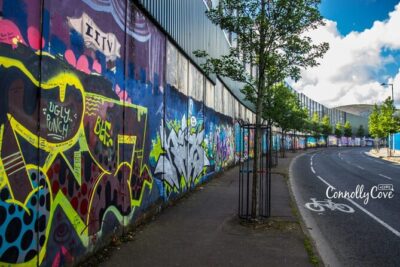
2 Hour Private Belfast Taxi Cab Tour of Troubles & Peace walls
See the full review →Browse the lists this tour appears in