
Reviewed · CITY TOURS
Belfast Official Private City Tour
Belfast’s past is written across its walls. This private tour takes you from Divis and Falls Road to Shankill Road, where murals, memorials, and the Peace Wall show how close the city’s divided communities still are. You also get a look at the Titanic Quarter and central landmarks, all without trying to piece the city together on foot.
I like the private vehicle, which saves time between neighborhoods, and the chance to ask direct questions instead of listening to a fixed group script. I also like the guide-led contrast between republican and loyalist areas. Guides Barry and Allan are named in the tour information, and Barry is praised for his clear storytelling and friendly manner.
The main drawback is the price: $615.91 per person is a serious outlay for roughly three hours, especially for a solo guest or couple. The value improves for a group that wants a private guide, hotel pickup, and a focused introduction to Belfast’s conflict rather than a longer public bus tour.
Key points to know before booking
- The Troubles are the main subject: Expect political murals, memorial gardens, interface areas, and the Peace Wall.
- You cover a lot of ground: Private transfers connect Falls Road, Shankill Road, Belfast Castle, the waterfront, and central Belfast.
- The tour shows both sides: Republican sites include Bobby Sands and Clonard, while Shankill Road introduces Ulster loyalist symbols and memorials.
- Belfast Castle adds a change of pace: You get about 30 minutes for views over Belfast and Belfast Lough.
- It is private, not a shared outing: Only your group takes part, with a professional local guide and air-conditioned transport.
- The schedule is tight: Most stops last 10 to 20 minutes, so this is an overview with explanations, photos, and short visits rather than a slow walking tour.
Why this private Belfast tour works
Belfast can be confusing on a first visit. Important sites are spread across different parts of the city, and the meaning of a mural is not always obvious from a photograph. A private vehicle lets you move between them quickly, while a local guide can explain the symbols and political language you are seeing.
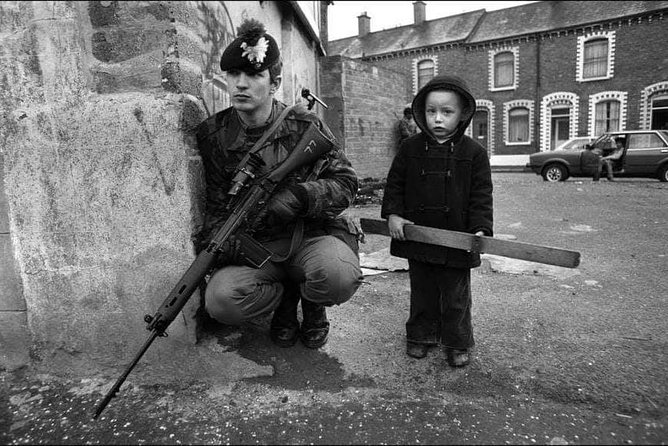
The tour focuses on the conflict commonly known as the Troubles, which lasted for more than 30 years. It does not treat the subject as a distant museum story. You see the roads, walls, memorials, and neighborhoods where those divisions shaped daily life.
I especially like the balance between the difficult sites and the broader city. After the Falls and Shankill areas, the route shifts to Belfast Castle, the Albert Memorial Clock, the Big Fish, the Beacon of Hope, and waterfront sights linked to the city’s past and present.
At around two hours and 40 minutes to three hours, this is not a full-day history course. You get a concentrated introduction. That makes it useful early in a Belfast stay, when you want a framework for the city, but less suitable if you want long visits inside attractions or time to study every mural.
A few more Belfast half-days to weigh up
- From Belfast: Giant’s Causeway Full-Day Guided Trip
★ 4.8 · 6,361 reviews - Titanic Belfast Entrance Ticket: Titanic Visitor Experience Including SS Nomadic
★ 4.5 · 3,698 reviews - Cab Tours Belfast Famous Black Taxi Tours
★ 5.0 · 3,633 reviews
Divis Tower and the first view of the divide
The tour begins at Divis Tower, near the meeting point of Falls Road and Shankill Road. The tower rises beside one of Belfast’s best-known interface areas, where republican and loyalist neighborhoods sit close together but have long been separated by political, religious, and community divisions.
You spend about 10 minutes here. That may sound brief, but the stop gives your guide a useful place to explain the geography before the murals begin. Look at how close the communities are. The short distance between them helps explain why walls, gates, and controlled routes became such a lasting part of Belfast life.
Because this is a vehicle-based tour, you are not asked to navigate the area alone. That matters here. You can focus on the explanation and the view rather than wondering which road leads where.
Falls Road and the International Mural Wall
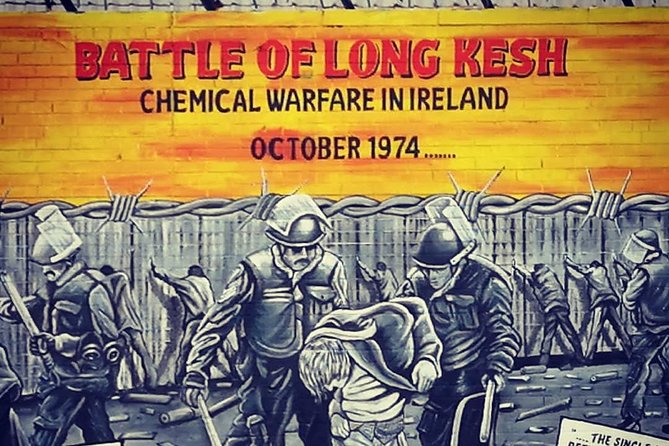
The International Wall on Divis Street is one of the tour’s strongest stops. You get about 20 minutes to see politically charged murals and street art associated with former prisoners of war and republican themes.
The wall is not just a photo backdrop. The artwork connects Belfast’s local struggle with political causes beyond Northern Ireland. Your guide can explain the people, symbols, and messages, helping you separate historical references from modern political expression.
This is one place where a private tour has a clear advantage. You can ask why a particular figure appears, what a phrase means, or how a mural relates to the wider conflict. A photograph alone rarely gives you that context.
The stop is still fairly short. If you love street art, you may wish you had more time to walk slowly along the wall. The tour gives you the essential view and explanation, then keeps moving.
The Peace Wall and a personal message
The Peace Wall, also called a peace line, remains one of Belfast’s most powerful sights. It physically separates communities that are still divided, even though the most intense years of the conflict have passed.
You have about 20 minutes here. You can write your name and leave a message of peace and hope, a small act that gives the visit a personal touch without turning the site into a simple tourist attraction.
I find the value of this stop lies in its awkwardness. The wall is often presented as a symbol of peace, but it is also a reminder that separation continues. Your guide’s handling of that tension matters. The tour description promises an explanation of Irish history and the division between communities, so you should expect the wall to be discussed as both a security measure and a sign of unfinished work.
Bring a pen if leaving a message matters to you. The information says you can sign the wall, but it does not specify that writing materials are supplied.
Same city, a completely different day out:
- A History of Terror – Belfast City Centre Walking Tour
★ 5.0 · 2,883 reviews - Game of Thrones and Giant’s Causeway Full-Day Tour from Belfast
★ 5.0 · 2,291 reviews - Private Black Taxi Belfast City Tour
★ 5.0 · 2,188 reviews - City Sightseeing Belfast Hop-On Hop-Off Bus Tour
★ 4.5 · 2,012 reviews
Bobby Sands and the republican story
The Bobby Sands mural is scheduled for about 10 minutes. It is one of Belfast’s most recognizable political murals, honoring the IRA volunteer who died during the 1981 hunger strike.
This stop gives you a direct entry into one of the most sensitive parts of the Troubles. Sands is viewed as a martyr by many republicans, while the British government and unionist communities have a very different reading of the campaign and its armed context.
You will get time for photographs and an explanation of the mural’s place in republican memory. Do not expect a long museum-style presentation. The strength here is the setting itself, followed by a local guide’s account of what the image means.
Clonard Monastery and the Martyrs Memorial Garden
Clonard Monastery, built in 1897 by the Naughton brothers, sits in the no-man’s-land area beside the peace line. You spend around 10 minutes at the large Roman Catholic monastery.
Its location is the important detail. The building is not simply an attractive religious site. It helps you understand how institutions and neighborhoods were positioned within Belfast’s divided geography.
The nearby Clonard Martyrs Memorial Garden receives about 15 minutes. Here you learn about the beginning of the present conflict in 1969 and see memorials for fallen volunteers of C Company, 2nd Battalion, Belfast Brigade, civilian casualties from the greater Clonard area, and republican prisoners who died between 1916 and 1970.
This can be an emotionally heavy portion of the tour. The memorial garden presents one community’s memory of loss, so listen carefully to how your guide places it within the wider story. A private format makes it easier to ask for clarification without holding up a group.
Shankill Road and loyalist murals
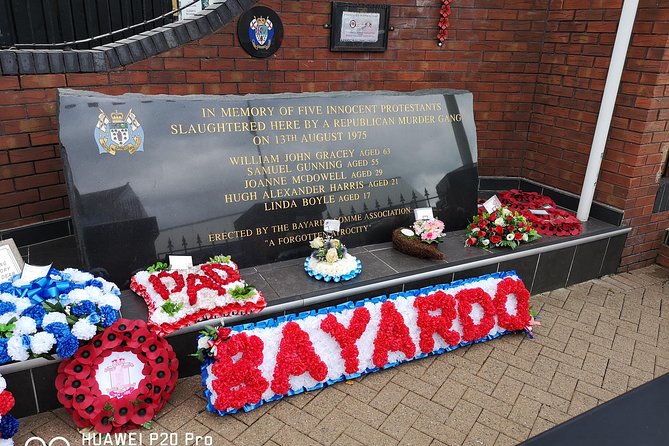
The route then crosses to Shankill Road, where you spend about 20 minutes seeing the King William mural, loyalist murals, and memorials connected with the UFF, UDA, and Ulster Volunteer Force.
This contrast with the Falls Road material is essential. If you only see republican murals, you get an incomplete picture of Belfast. Shankill Road shows Ulster loyalism, its links to British identity, and the way armed groups and community memory appear in public art.
The King William imagery refers to William of Orange, a major symbol for many unionists and loyalists. The paramilitary murals are more difficult to read from the outside. Your guide can explain what the symbols mean and how the murals function within the community.
Be respectful with your camera. The tour allows you to see and photograph the sites, but these are living neighborhoods, not an open-air theme park. Follow your guide’s lead, avoid intrusive photos of residents, and pay attention to the explanation rather than rushing from mural to mural.
Belfast Castle and views from Cavehill
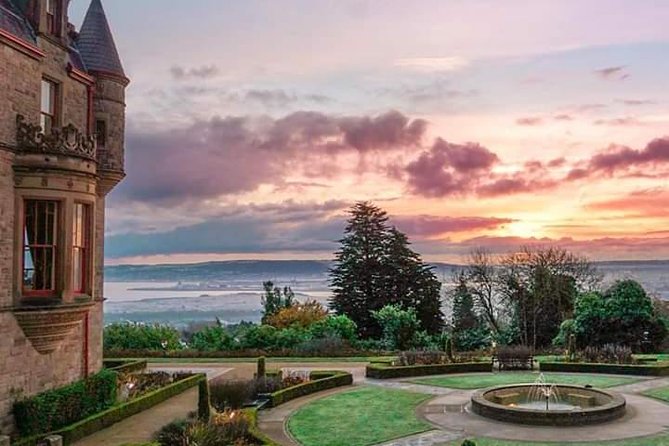
Belfast Castle provides a welcome change of pace. The castle sits on the slopes of Cavehill Country Park, around 400 feet above sea level, and the tour allows about 30 minutes here.
You get broad views over Belfast and Belfast Lough. After the close streets and political walls, the height helps you understand the city’s shape. It is also one of the few stops with enough time to pause, take photographs, and enjoy the setting.
The information describes the first Belfast Castle as a Norman building constructed in the city center in the late 12th century. The present visit focuses on the castle site and its views, not on a long interior tour. Keep that distinction in mind if you expect a major castle attraction with extensive rooms and displays.
This is probably the most relaxed stop on the route. If you are choosing between a purely political mural tour and this wider city circuit, the castle is one reason to choose the private option.
Albert Memorial Clock and the waterfront
Back in central Belfast, the Albert Memorial Clock takes about 10 minutes. Completed in 1869, the clock tower sits in Queen’s Square and is one of Belfast’s best-known landmarks.
The stop is short and mainly suited to photographs and a quick explanation. The tower is an easy reminder that Belfast is more than its conflict sites. Its civic architecture reflects the city’s 19th-century growth and public ambitions.
The Big Fish, also called the Salmon of Knowledge, is another 10-minute stop. John Kindness created the 10-meter ceramic mosaic sculpture in 1999, and it sits on Donegall Quay near the Lagan Lookout and Custom House.
The tiled surface makes this an appealing close-up subject. You can look for the printed images across the sculpture, then connect the waterfront setting with Belfast’s modern public art. It is a lighter stop after the memorials and murals.
The itinerary also includes the Beacon of Hope, or Thanksgiving Square Beacon. This 19.5-meter metal sculpture by Andy Scott was built in 2007 at a cost of £300,000. Its nicknames include Nuala with the Hula, the Belle on the Ball, the Thing with the Ring, and the Angel of Thanksgiving.
You may hear one of those local names during the visit. The sculpture is currently the second-largest public art piece in Belfast, after Rise on Broadway Roundabout. It gives the tour a final look at how the city uses public art for civic identity rather than only political messaging.
St Peter’s Cathedral and the return to the west
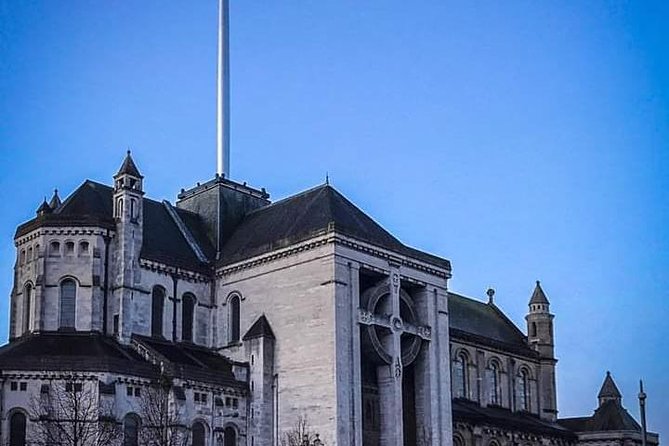
St Peter’s Cathedral is located in the Divis Street area of the Falls Road. Construction began in the 1860s, and it serves as the Roman Catholic cathedral for the Diocese of Down and Connor.
The scheduled visit lasts about 10 minutes. This is another short orientation stop, not a lengthy cathedral visit. Its value comes from location and context. After seeing the Falls Road murals and Clonard memorials, the cathedral adds a religious and institutional layer to the area.
The route’s order may vary, since private tours can adjust to traffic and the guide’s judgment. The supplied schedule lists both west Belfast sites and central landmarks, but you should think of the experience as a moving city circuit rather than a rigid walking sequence.
What the private format really gives you
Private transport is more than a comfort feature here. The key sites are spread out, and walking between them would take much longer than the tour’s three-hour window. With an air-conditioned vehicle and a driver handling navigation, you can see more while keeping your energy for the explanations.
Hotel pickup and drop-off are offered, which is useful if you are staying in Belfast. Train and bus station pickup is limited to central Belfast, with extra charges outside the central area. Airport transfers also cost extra, so do not assume airport pickup is part of the standard service.
Only your group participates. That means you can ask about sensitive subjects, request clarification, and spend a little longer at a stop when timing allows. It also means the guide’s quality has a large effect on the day. Barry is specifically identified as a guide, and the available comments describe him as friendly, informative, and strong on Irish, British, and Northern Irish history. Allan is also associated with the tour service.
The tour includes a professional qualified local guide, private transportation, and an air-conditioned vehicle. A top-of-the-range Mercedes-Benz V-Class upgrade may be available for £30, but availability is not guaranteed.
Is $615.91 per person good value?
At $615.91 per person, this is expensive for an experience lasting less than three hours. You can see many Belfast landmarks independently, and several outdoor murals and public artworks do not require an admission fee.
The price is easier to justify if you are traveling with a larger private group and want a guide who can explain both republican and loyalist perspectives. You are paying for door-to-door convenience, private transport, local interpretation, and a route that links sites many people would struggle to combine efficiently.
It is less convincing value for a budget-minded solo visitor, particularly if you mainly want to photograph the Peace Wall, Big Fish, or the Beacon of Hope. One point from the tour feedback is useful here: you do not need to pay for a gift center or bus visit to appreciate Belfast’s public sights. Much of the outdoor material can be seen freely at your own pace.
The free cancellation policy allows a full refund if you cancel at least 24 hours before the start time. Changes or cancellations made less than 24 hours before the start are not accepted for a refund.
Who should book this Belfast tour?
I would choose this tour if you want the Troubles explained clearly, prefer a private setting, or have limited time in Belfast. It suits families, couples, and small groups who value hotel pickup and do not want to manage routes between west Belfast, the castle, and the waterfront.
It is also a good first-day option. The guide can give you a working map of the city and explain why the murals and peace lines matter before you explore on your own.
I would hesitate if you want long walks, museum interiors, or a slow photographic tour. The schedule moves quickly, with most stops lasting only 10 to 20 minutes. If you are traveling alone or as a pair, compare the total private price with a shared black cab or public walking tour before booking.
Book it for the guide, the context, and the efficient route, not for admission to a string of indoor attractions. The experience is strongest when you want Belfast’s difficult story presented beside its civic landmarks, waterfront art, and high views from Cavehill.
FAQ
How long does the Belfast Official Private City Tour last?
The tour lasts approximately two hours and 40 minutes to three hours.
Is hotel pickup included?
Yes. Round-trip hotel pickup and drop-off are included. Train and bus station transfers are limited to central Belfast, with extra costs outside the central area.
Is this a private tour?
Yes. Only your group participates, with a private vehicle and a professional local guide.
What parts of Belfast’s conflict does the tour cover?
The tour visits Divis Tower, the International Mural Wall on Divis Street, the Peace Wall, the Bobby Sands mural, Clonard Monastery, Clonard Martyrs Memorial Garden, and loyalist murals and memorials on Shankill Road.
Does the tour include Belfast Castle and central landmarks?
Yes. The route includes Belfast Castle, the Albert Memorial Clock Tower, the Big Fish, St Peter’s Cathedral, and the Beacon of Hope.
Can I cancel for a full refund?
Yes, if you cancel at least 24 hours before the experience start time. Cancellations or changes made less than 24 hours before the start time are not accepted for a refund.
Just added around Belfast
- Game of Thrones scene location inc Giants causeway from Belfast★ 5.0 · 3 reviews
- Belfast history of terror & mural 1 hr express private taxi tour★ 5.0 · 3 reviews
- Giants Causeway Tour From Belfast including Game of thrones sites★ 5.0 · 3 reviews
- Experience the Antrim Coast and the Land of Giants – Private Tour★ 5.0 · 3 reviews
- Private Coast Tour in Belfast★ 5.0 · 3 reviews
- Belfast & Giants Causeway Luxury Mercedes Private Tour for 6 pax★ 5.0 · 3 reviews
- Belfast to Dublin Transfer★ 5.0 · 3 reviews
- Belfast City Airport (BHD) to Belfast Accommodation – Arrival Private Transfer★ 5.0 · 3 reviews
City Tours, compared.
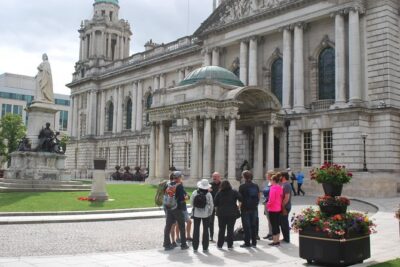
A History of Terror – Belfast City Centre Walking Tour
See the full review →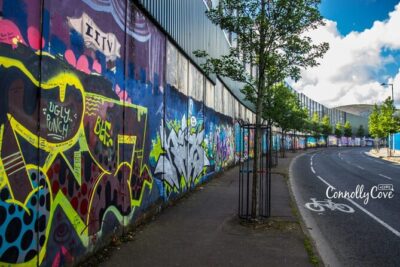
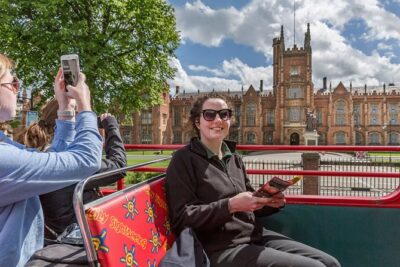
City Sightseeing Belfast Hop-On Hop-Off Bus Tour
See the full review →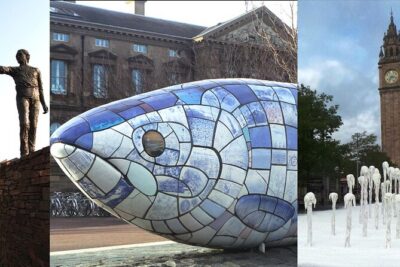
Belfast Eclectic Walking City Center Experience, The Marti Way
See the full review →
Shore Excursion from Belfast: Including Giants Causeway and Belfast City.
See the full review →
Giant’s Causeway and Belfast City Murals Tour inc Game of Thrones Dark Hedges
See the full review →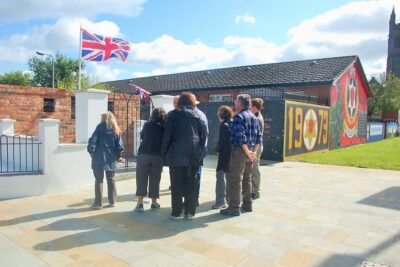
World Famous Belfast City Centre Black Cab/Taxi Tour 2 Hours
See the full review →Browse the lists this tour appears in